

Solar power transformed the way the world generates electricity. Battery Energy Storage Systems (BESS) are transforming how electricity is delivered, managed, and used.
The first chapter of renewable energy was remarkably successful. Between 2010 and today, countries concentrated on deploying as much renewable generation as possible with the clear objective of replacing fossil-fuel generation with clean electricity.
Technology improvements, economies of scale, and supportive government policies dramatically reduced costs. Today, solar electricity is often cheaper than building new coal-fired power plants, fundamentally changing energy economics worldwide.
However, success has created a new challenge.
Solar generation is concentrated during daylight hours, particularly around midday. Electricity demand, on the other hand, often peaks in the evening when homes, offices, and industries require more power but solar production begins to fall. This growing mismatch between when electricity is produced and when it is needed has become one of the defining challenges of modern power systems.
In other words, the world’s energy challenge has evolved from generation to integration.
Ironically, one of the biggest challenges facing renewable energy today is not producing enough electricity. It is producing more electricity than the grid can absorb at certain times and instructing renewable generators to reduce output.
This phenomenon is known as renewable energy curtailment.
Curtailment occurs when a solar or wind plant is capable of generating electricity but is prevented from doing so because the electricity cannot be transported, balanced, or consumed safely by the grid.
One example of curtailment in India is Rajasthan. Blessed with abundant sunshine, the state has become India’s renewable energy powerhouse with solar installed capacity of 42166 MW. Rajasthan commissioned renewable projects at breakneck speed, but, generation outpaced transmission infrastructure development.
In 2025, developers reported widespread curtailment of operational solar and wind projects as transmission corridors became congested. Rajasthan has approximately 23 GW of commissioned renewable energy capacity. The available evacuation margin stands at 18.9 GW. About 4 GW of generation capacity has nowhere to go. During peak solar hours between 11 am and 2 pm, 26 commissioned projects with a combined capacity of 3,287 MW under T-GNA are experiencing 100% curtailment.
This is a powerful reminder that building more solar plants alone is not enough. Without matching investments in transmission, storage, and grid flexibility, valuable clean electricity risks being wasted.
If your business runs on High-Tension industrial or commercial power and you already have, or are planning, rooftop or open-access solar, a decision about battery storage is no longer optional homework for next year. It has become a live financial question this year, for three reasons that have changed the math for any energy-intensive business:
The question for most energy-intensive businesses today is not “should we add storage” but “what does it cost us not to.”
At its simplest, a BESS is a system that stores electricity for later use. But in practice, it is far more than a large battery. Modern BESS installations combine advanced battery technology with sophisticated power electronics, intelligent software, and real-time energy management systems that decide when electricity should be stored, when it should be used, and when it should be supplied back to the grid.
Think of a Battery Energy Storage System as a buffer between electricity generation and electricity consumption. With storage, excess electricity can be captured when it is abundant and inexpensive, then released hours later when demand increases, electricity prices rise, or the grid requires additional support.
Battery Energy Storage Systems are not a replacement for transmission infrastructure or a solution to every grid challenge. However, BESS complements the grid by reducing pressure on it, storing excess renewable energy when supply exceeds demand, and releasing it when needed.
This flexibility creates value at both the grid and facility level. For businesses, a BESS can increase the use of self-generated solar power, reduce expensive peak demand charges or reliance on expensive generators, provide near-instant backup during outages, and improve power quality for sensitive operations. At the grid level, battery storage helps balance supply and demand, reduces renewable energy curtailment, and supports greater integration of solar and wind power.
Solar alone solves a generation problem: it gives you cheaper electricity when the sun is up. It does nothing for the hours your business actually needs power, most evenings, late operations, peak machinery loads. Storage is what turns solar from a partial offset into a genuine tool against your single largest controllable input cost.
Take a real, current example from a Maharashtra High-Tension industrial consumer on Time-of-Day (TOD) billing. Under MERC’s TOD framework, daytime solar generation (9 AM–5 PM) is banked as net-metering credit, but those credits can only be redeemed against daytime consumption; they cannot offset evening peak-hour bills. Evening and night consumption (5 PM–midnight) carries a 20% surcharge on top of the normal tariff. Here is a breakdown of what happens:
A battery does one simple thing here: it captures the cheap daytime unit and lets you use it yourself in the evening, instead of selling it cheap and buying it back expensive.
One of the biggest misconceptions about battery storage is that the battery should match the size of the solar plant. In reality, there is no universal formula. A 500 kWp solar system does not automatically require a 500 kWh battery.
(Note: Understanding kW vs kWh: A useful analogy is a water tank. kW (kilowatts) tells you how fast water flows through the pipe. kWh (kilowatt-hours) tells you how much water the tank can hold. Similarly, Battery power (kW) determines how quickly electricity can be supplied. Battery capacity (kWh) determines how long it can supply electricity. )
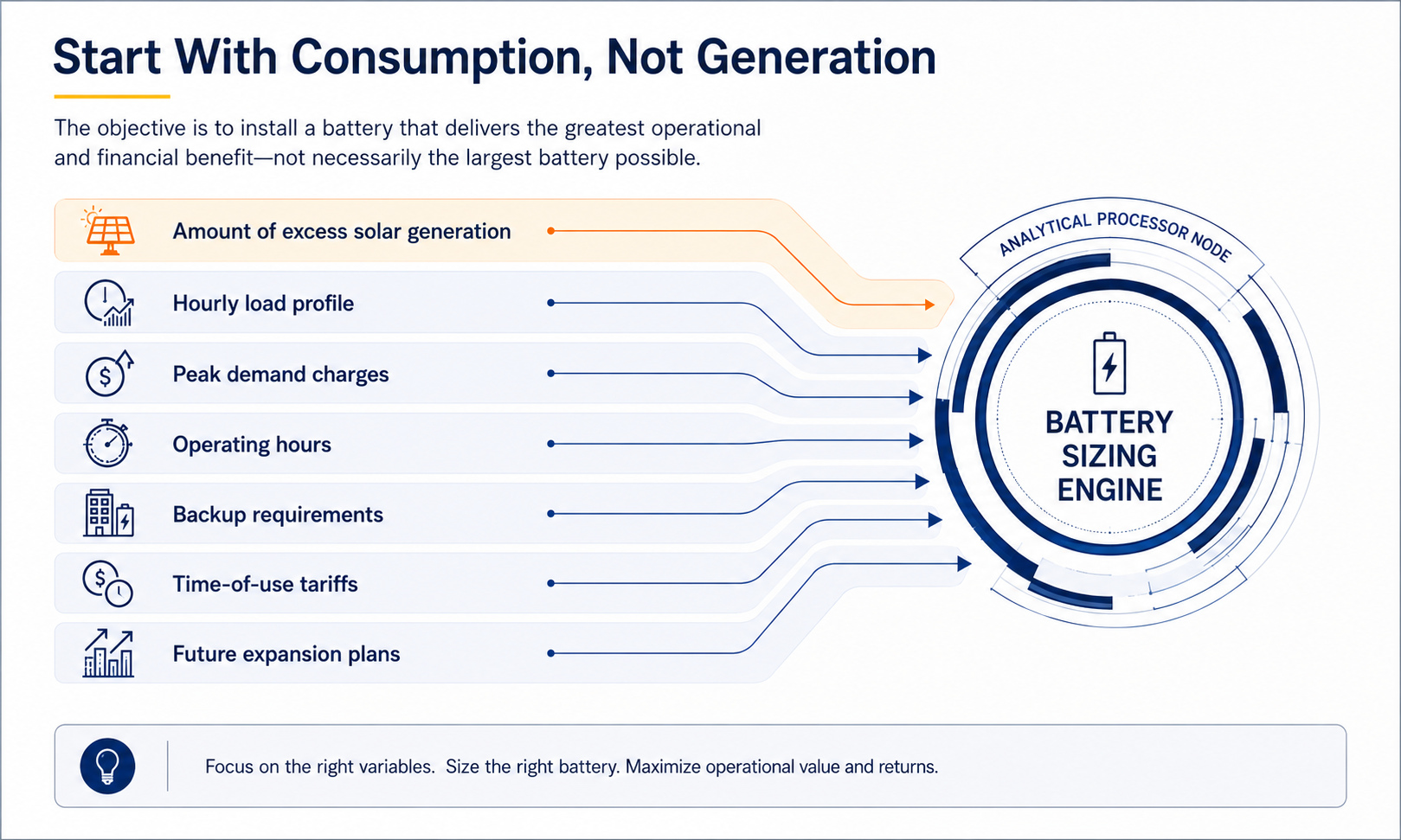
Battery sizing begins with understanding how the facility consumes electricity, not simply how much electricity the solar plant generates. Engineers typically analyze several factors, including:
The objective is to install a battery that delivers the greatest operational and financial benefit—not necessarily the largest battery possible.
|
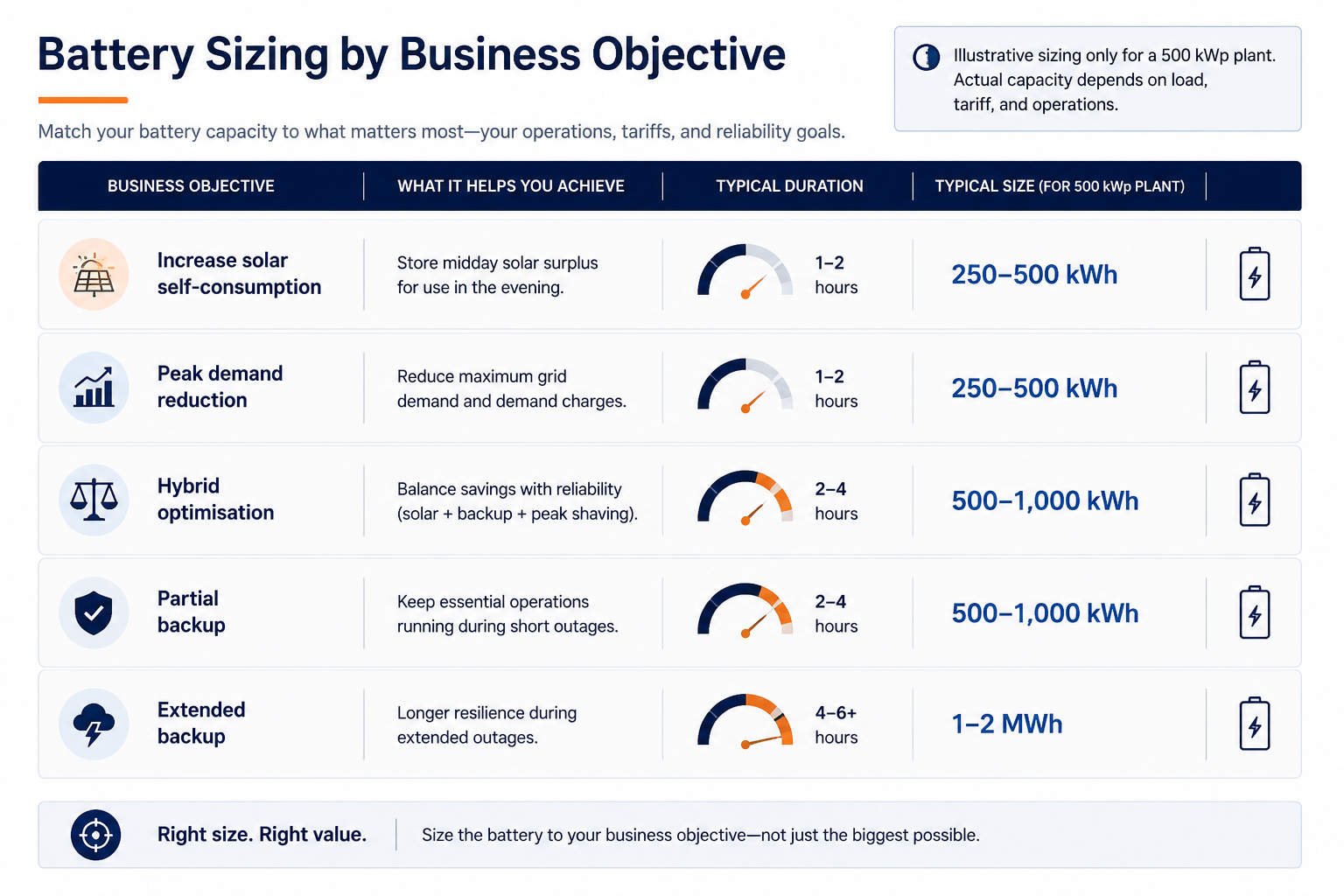
Business Objective |
Typical Battery Duration |
Typical Battery Size for a 500 kWp Solar Plant* |
Primary Benefit |
|
Increase solar self-consumption |
1–2 hours |
250–500 kWh |
Store midday surplus for evening use |
|
Peak demand reduction |
1–2 hours |
250–500 kWh |
Reduce maximum grid demand |
|
Partial backup for critical loads |
2–4 hours |
500–1,000 kWh |
Keep essential operations running |
|
Extended backup during outages |
4–6+ hours |
1–2 MWh |
Longer resilience and business continuity |
|
Hybrid optimisation (solar + backup + peak shaving) |
2–4 hours |
500–1,000 kWh |
Balance savings with reliability |
Illustrative sizing only. Actual battery capacity depends on the facility’s load profile, tariff structure, and operational requirements.
|
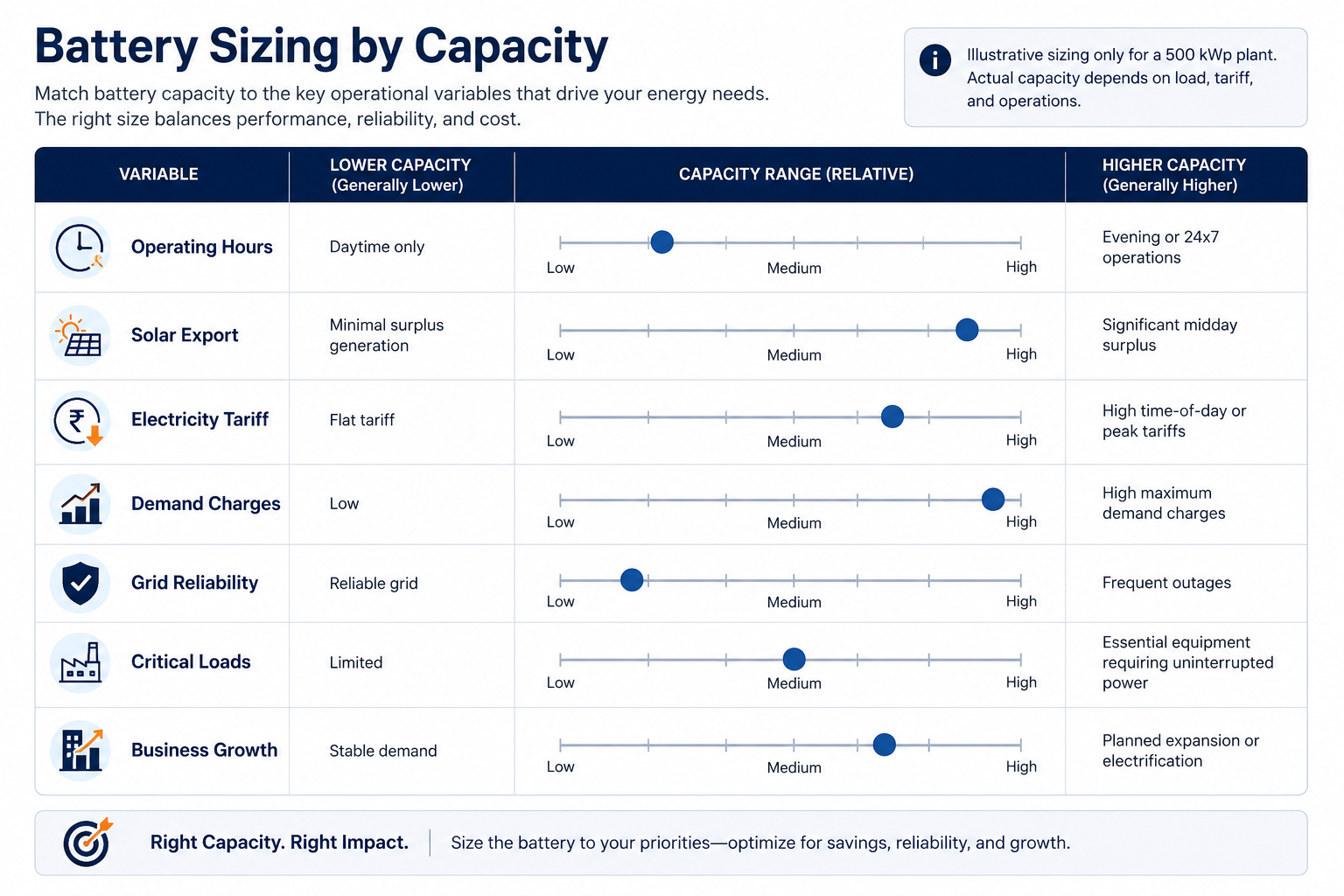
Factor |
Smaller Battery May Be Enough |
Larger Battery May Be Better |
|
Operating Hours |
Daytime only |
Evening or 24×7 operations |
|
Solar Export |
Minimal surplus generation |
Significant midday surplus |
|
Electricity Tariff |
Flat tariff |
High time-of-day or peak tariffs |
|
Demand Charges |
Low |
High maximum demand charges |
|
Grid Reliability |
Reliable grid |
Frequent outages |
|
Critical Loads |
Limited |
Essential equipment requiring uninterrupted power |
|
Business Growth |
Stable demand |
Planned expansion or electrification |
|
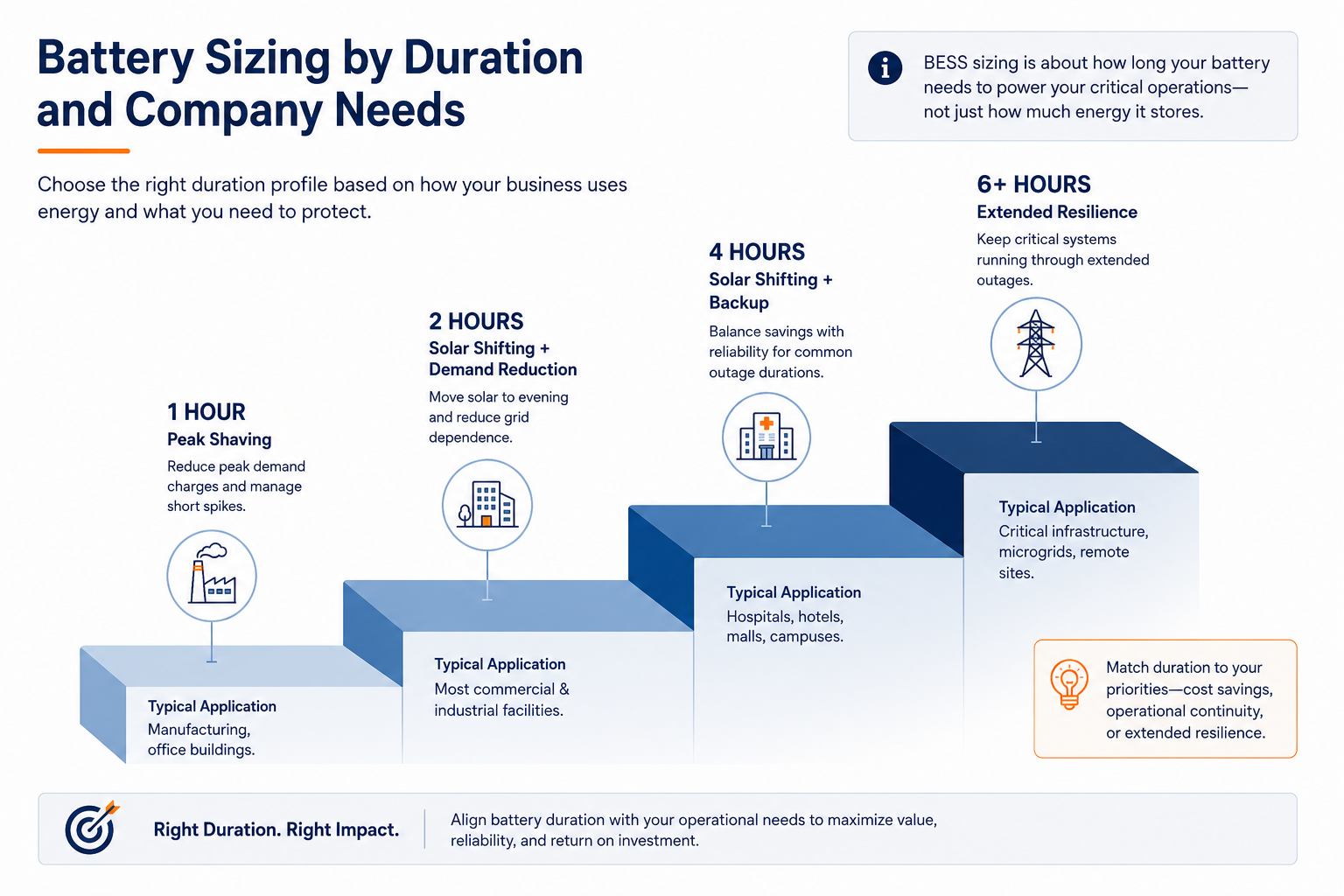
Battery Duration |
Best For |
Typical Commercial Application |
|
1 Hour |
Peak shaving |
Manufacturing, office buildings |
|
2 Hours |
Solar shifting + demand reduction |
Most commercial & industrial facilities |
|
4 Hours |
Solar shifting + backup |
Hospitals, hotels, malls, campuses |
|
6+ Hours |
Extended resilience |
Critical infrastructure, microgrids, remote sites |
This introduces the concept of battery duration, which is how the industry often discusses BESS (e.g., “a 2-hour” or “4-hour” battery). It also helps readers understand why a 500 kW / 1,000 kWh system is called a 2-hour BESS, making later conversations with vendors much easier.
A light manufacturing facility with a 500 kWp rooftop solar plant operates from 8:00 AM to 10:00 PM, resulting in significant electricity demand after solar generation declines. By adding a 500 kWh / 250 kW Battery Energy Storage System, the facility stores surplus daytime solar energy and uses it during evening operations, improving overall system utilisation.
|
Parameter |
Before BESS |
After BESS |
|
Connected Load |
700 kW |
700 kW |
|
Peak Demand |
650 kW |
530 kW |
|
Solar Plant Capacity |
500 kWp |
500 kWp |
|
Battery System |
— |
500 kWh / 250 kW |
|
Annual Solar Generation |
730,000 kWh |
730,000 kWh |
|
Solar Self-Consumption |
440,000 kWh (60%) |
600,000 kWh (82%) |
|
Solar Exported |
290,000 kWh (40%) |
130,000 kWh (18%) |
|
Additional Solar Utilised On-site |
— |
+160,000 kWh/year |
|
Peak-Hour Grid Imports |
High |
~30% Lower |
|
Diesel Generator Runtime* |
~120 hrs/year |
<20 hrs/year |
|
Grid Dependence During Evening |
High |
Moderate |
*Where battery backup is integrated with the emergency power system.
The battery does not generate additional electricity—it allows the business to extract more value from the electricity it already produces. In this example, a properly sized BESS increases solar self-consumption from 60% to 82%, shifts 160,000 kWh of renewable energy from midday to evening use, and reduces peak demand by approximately 18%.
Note: This case study is illustrative. Actual battery sizing, savings and payback depend on the facility’s load profile, tariff structure, operational hours and backup requirements.
These are the questions that separate businesses that get the outcome they modeled from those that get an unpleasant surprise eighteen months in.
|
Question |
Why It Matters |
|
What is our current electricity cost structure — and specifically, how much of it is evening/peak versus daytime? |
Pull 12 months of actual DISCOM bills, broken down by Time-of-Day slab, not just the monthly total. |
|
Does our state still offer free or favourable solar banking, and is that at risk of changing? |
Check your state’s most recent DISCOM tariff order — several states have changed this in the last 12 months. |
|
Do we have the taxable profit to make CAPEX’s depreciation benefit actually valuable? |
If your business runs at a loss or under a trust structure, OPEX usually outperforms CAPEX despite the headline tariff gap. |
|
What is our realistic time horizon at this site? |
CAPEX favours 8+ year horizons; if relocation or major operational change is likely sooner, OPEX reduces stranded-asset risk. |
|
Is co-located storage now mandatory for new solar capacity in our state? |
This has shifted from optional to mandatory in some states for new installations above certain thresholds — check before finalising a solar-only design. |
|
What happens if our chosen developer fails or is acquired? |
Confirm a step-in or operator-substitution clause exists in any OPEX/RESCO contract before signing. |
For any business with meaningful evening or continuous-shift load, the practical question in 2026 is no longer whether storage pays for itself – it does typically within 3 to 6 years – but which ownership model fits your specific tax position, balance sheet, and time horizon.
The businesses moving fastest on this in 2026 are not doing so primarily for sustainability reasons. They are doing it because the arbitrage between cheap daytime solar and expensive evening grid power has become too large, and too persistent, to leave unaddressed on the P&L.
Before approaching vendors, get an internal, tariff-specific savings model built from your own 12 months of DISCOM bills. Most credible solar plant companies – like ours – will build this for you at no cost as part of a sales process; treat that as the starting point for comparing options, not the final answer.