
Solar power transformed the way the world generates electricity. Battery Energy Storage Systems (BESS) are transforming how electricity is delivered, managed, and used. In this article, we focus on how BESS can be integrated into commercial and industrial ecosystems. In part 2, we will discuss solar battery storage in the residential context.
For years, rooftop solar has been one of the best ways for businesses to reduce electricity costs. Generate your own power during the day, consume less from the grid, and lower your energy bills.
That equation is changing.
Many businesses now generate more solar power than they can use during daylight hours. The surplus is exported to the grid, often at a relatively low value. A few hours later, when the sun sets and operations continue, that same business buys electricity back from the grid at much higher evening tariffs.
In other words, you are selling electricity when it’s cheap and buying it back when it’s expensive.
Battery Energy Storage Systems (BESS) solve this problem by storing excess daytime solar and using it later, when electricity costs are highest. Instead of simply generating clean energy, businesses can maximise the value of every unit they produce.
The same timing challenge exists across the entire electricity system.
Solar generation peaks during the middle of the day, while electricity demand often peaks in the evening. As more renewable energy is added to the grid, there are times when more solar power is available than the grid can immediately use or transport. In some cases, renewable generators are asked to reduce their output—a process known as curtailment.
This highlights a broader reality: the future of renewable energy is no longer just about generating more electricity. It’s about storing it and using it when it creates the greatest value. The same principle applies to businesses. A battery bridges the gap between when solar power is generated and when it’s needed most.
At its simplest, a Battery Energy Storage System (BESS) stores electricity for later use.
Think of it as a bank account for the energy your solar plant generates. Instead of exporting surplus electricity to the grid during the day, a battery stores it on-site. When the sun goes down or electricity prices increase, your business uses the stored energy instead of buying expensive grid power.
The system operates automatically. Intelligent software decides when to charge the battery, when to discharge it, and when drawing power from the grid makes the most sense.
For businesses, this delivers several benefits:
Simply put, solar generates low-cost electricity. Battery storage helps you use that electricity when it delivers the greatest financial value.
The value of battery storage comes from one simple idea: use more of the electricity you generate yourself, and buy less from the grid when electricity is most expensive. Every unit of electricity used from the battery is one less unit purchased from the grid at peak prices.
Consider a manufacturing facility in Maharashtra operating under Time-of-Day tariffs. Under the Maharashtra Electricity Regulatory Commission (MERC)’s framework, daytime solar generation (9 AM to 5 PM) is banked as net-metering credit, but those credits can only be redeemed against daytime consumption; they cannot offset evening peak-hour bills. Evening and night consumption (5 PM to midnight) carries a 20% surcharge on top of the normal tariff. Here is a breakdown of what happens:
Without storage, that difference becomes a daily cost. With a battery, excess daytime solar is stored and used after sunset instead of being exported, reducing expensive evening electricity purchases.
The exact savings vary depending on your tariff, operating hours, and energy consumption. But for businesses with significant evening loads, battery storage can substantially improve the financial returns from an existing or planned solar installation.
One of the biggest misconceptions about battery storage is that the battery should match the size of the solar plant.
It doesn’t.
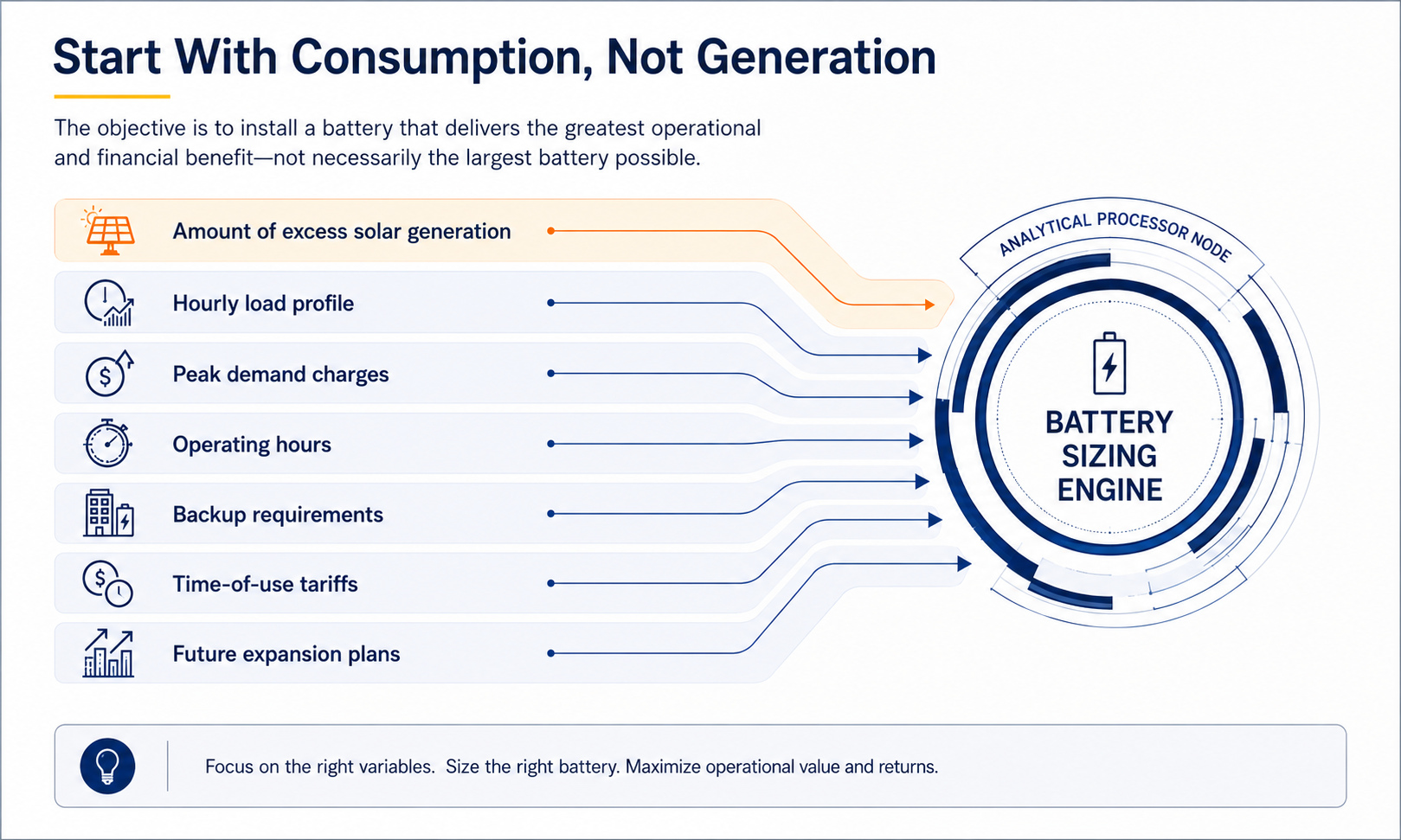
A 500 kWp solar system does not automatically require a 500 kWh battery. The right battery depends on how your business uses electricity, not simply how much solar it generates. Engineers typically analyse:
The objective isn’t to install the biggest battery. It’s to install the battery that delivers the highest financial return for your business.
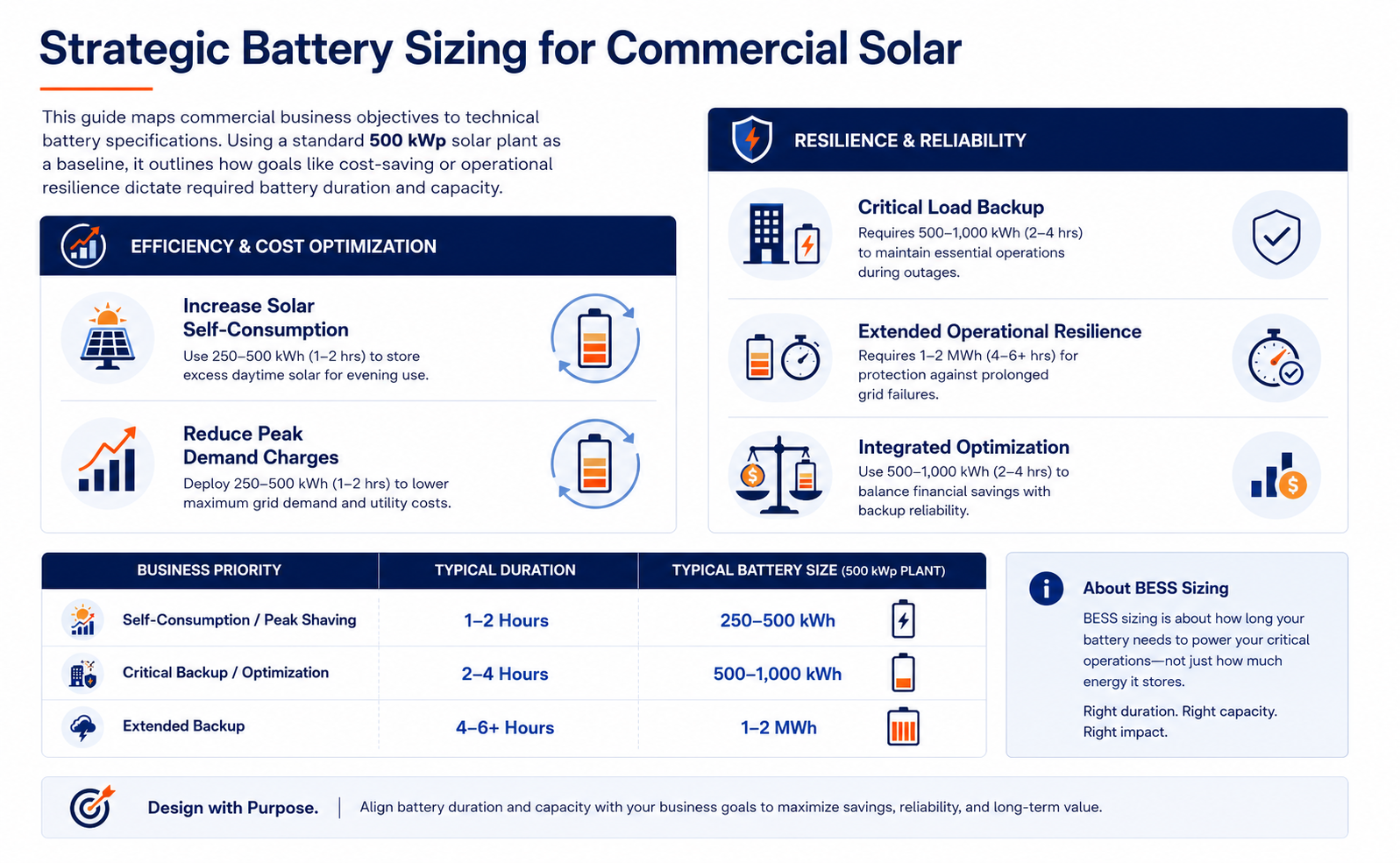
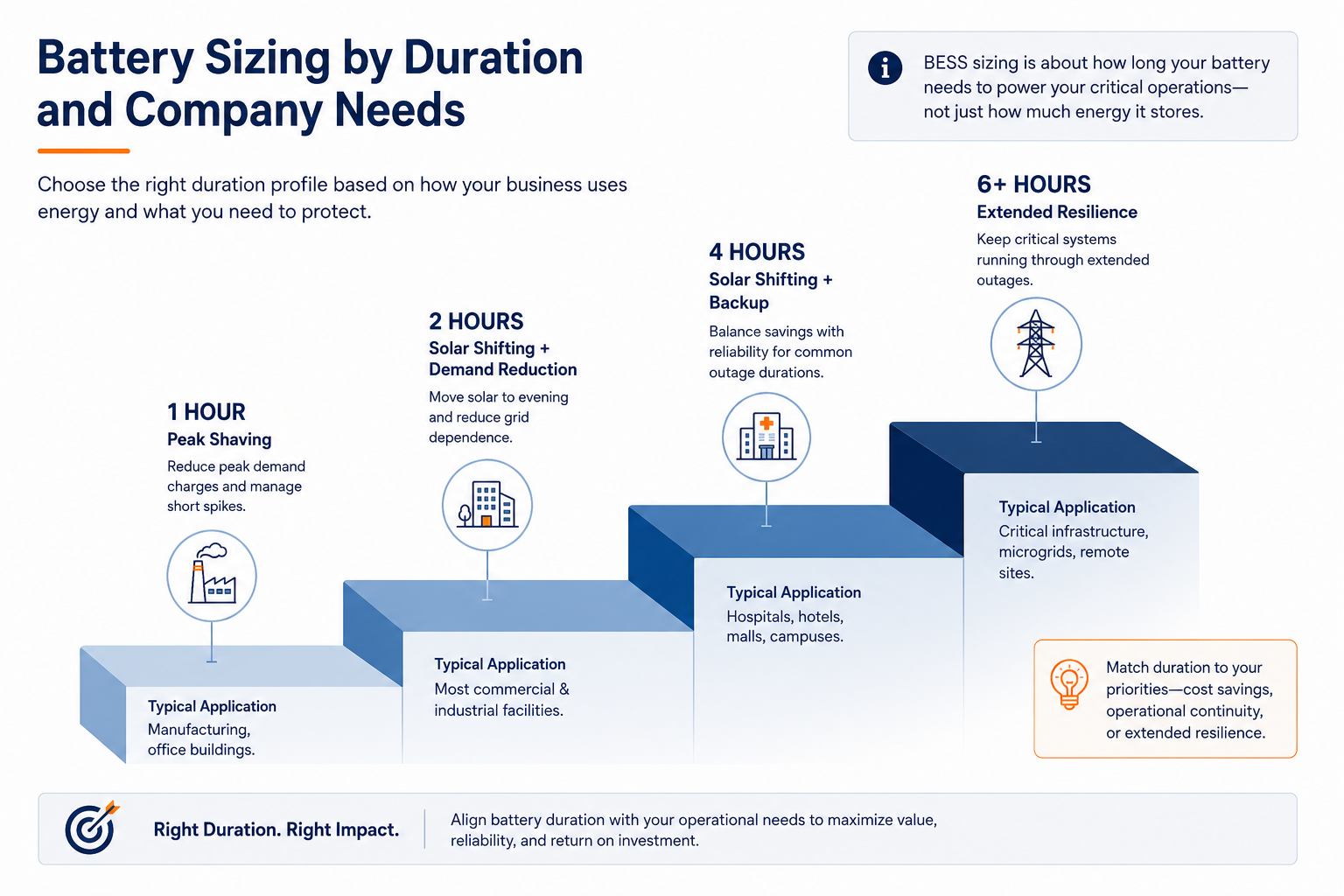
Before choosing a battery, it’s important to decide what you want it to do. Different business objectives require different battery capacities and durations.
|
Business Objective |
Typical Battery Duration |
Typical Battery Size for a 500 kWp Solar Plant* |
Primary Benefit |
|
Increase solar self-consumption |
1–2 hours |
250–500 kWh |
Store excess daytime solar for evening use |
|
Reduce peak demand charges |
1–2 hours |
250–500 kWh |
Lower maximum grid demand |
|
Partial backup for critical loads |
2–4 hours |
500–1,000 kWh |
Keep essential operations running during outages |
|
Extended backup |
4–6+ hours |
1–2 MWh |
Longer resilience during prolonged outages |
|
Solar + backup + peak optimisation |
2–4 hours |
500–1,000 kWh |
Balance savings with reliability |
Illustrative sizing only. Actual battery capacity depends on the facility’s electricity consumption, tariff structure, and operational requirements.
These are the questions that separate businesses that get the outcome they modeled from those that get an unpleasant surprise 18 months in.
|
Question |
Why It Matters |
|
When does our business use the most electricity? |
If most of your consumption happens during the evening or night, battery storage can help reduce expensive grid purchases. |
|
How much excess solar do we generate? |
Review your electricity bills and solar generation data to understand how much energy is being exported during the day. The more surplus solar you have, the greater the opportunity to use it yourself instead. |
|
What does our electricity tariff look like? |
Businesses with Time-of-Day tariffs or high peak demand charges often see the greatest financial benefit from battery storage. |
|
Do we need backup power? |
If production, healthcare, hospitality, or critical equipment cannot tolerate outages, battery storage can also improve business continuity. |
|
What are we trying to achieve? |
Some businesses want to maximise savings. Others want reliable backup power, lower peak demand, or a combination of all three. The right battery depends on your priorities—not simply the size of your solar plant. |
For any business with meaningful evening or continuous-shift load, the practical question in 2026 is no longer whether storage pays for itself – it does typically within 3 to 6 years – but which ownership model fits your specific tax position, balance sheet, and time horizon.
The businesses moving fastest on this in 2026 are not doing so primarily for sustainability reasons. They are doing it because the arbitrage between cheap daytime solar and expensive evening grid power has become too large, and too persistent, to leave unaddressed on the P&L.
Before approaching vendors, get an internal, tariff-specific savings model built from your own 12 months of DISCOM bills. Most credible solar plant companies – like ours – will build this for you at no cost as part of a sales process; treat that as the starting point for comparing options, not the final answer.