

If you have rooftop solar at home, winter can bring a few surprises. The days are shorter, the sun sits lower in the sky, and in many parts of North India, fog and haze can keep sunlight from reaching your panels. You may notice your daily generation falling, even when your system is clean and working as it should.
The good news? Solar panels don’t need scorching temperatures to work well. In fact, cooler weather can help them operate more efficiently. The key is understanding what changes naturally with the season, what you can do to keep your system performing well, and when a drop in generation deserves closer attention.
Solar panels generate electricity when sunlight reaches their photovoltaic cells. The amount of electricity they produce depends on how much sunlight is available, how directly it reaches the panels, the panels’ operating temperature, and the condition of the system. Winter changes several of these factors at once.
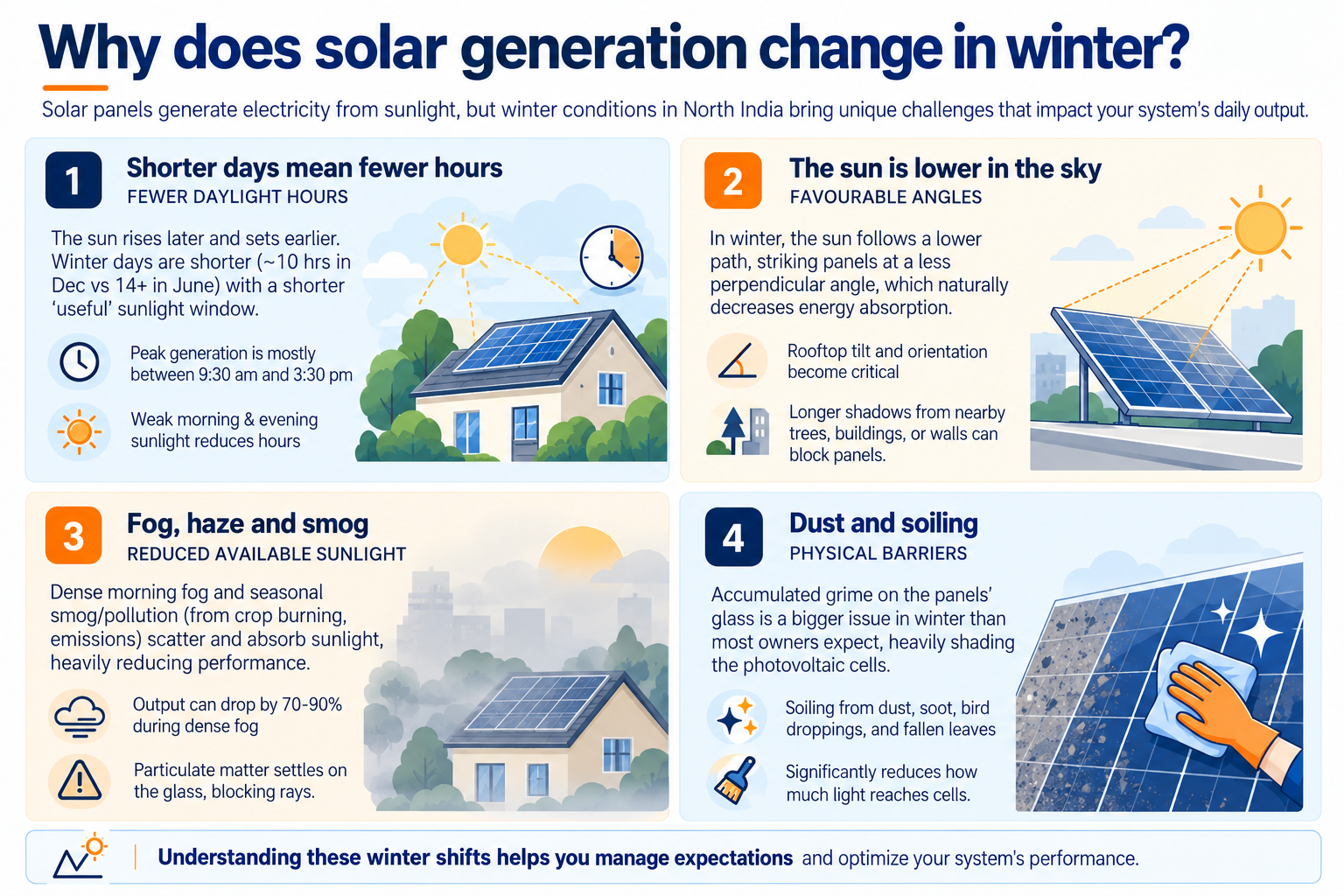
In winter, the sun rises later and sets earlier. Your solar system therefore has fewer daylight hours in which to generate electricity. For example, in Delhi, the day is about 10 hours long in late December compared to 14+ hours in June. The useful window is shorter still. Sunlight in the first and last hour or two is weak, and on foggy mornings production may not begin properly until late morning. On a clear December day, most of your energy comes between roughly 9:30 am and 3:30 pm.
The sun’s position changes through the year. During winter, it follows a lower path across the sky, changing the angle at which sunlight reaches your rooftop panels. Solar panels generally receive more direct sunlight when the sun’s rays strike them closer to perpendicular. When sunlight arrives at a less favourable angle, the energy reaching the panel can decrease.
This is particularly relevant for fixed rooftop systems, which are installed at a set angle and do not follow the sun. It is also why roof orientation, panel tilt and surrounding obstructions matter. A nearby building, parapet wall or tree that casts little shade in summer may create a longer shadow across your panels in winter.
Fog is the biggest single swing factor in the plains. From late December to mid-January, dense radiation fog often covers Punjab, Haryana, Delhi and Uttar Pradesh every morning, and in cold-wave spells it can sit for several days. Under dense fog, only diffuse light reaches the panels. Solar panels can still generate electricity in these conditions, but output may be much lower (10-30% of usual generation) during periods of dense fog or persistent haze.
From October to January, crop-residue burning, vehicle and industrial emissions, firecracker smoke after Diwali, and low winter wind speeds can push AQI into the severe range across Delhi-NCR and the plains. Fine particles scatter and absorb sunlight, so even a seemingly sunny day can produce noticeably less. The same particles settle on the glass.
Soiling, the film of dust, soot, bird droppings and leaves on the glass, is a bigger winter issue in North India than many owners expect:
A few weeks of heavy soiling can cost several percent of output, and in heavily polluted areas it can reach double digits.
One of the most useful things to understand is that winter generation follows a different daily pattern from summer generation. Comparing a December day directly with a peak summer day can make normal seasonal changes look like a fault.
Here’s what you may notice.
|
What you notice |
Why it happens |
|
Lower total generation per day |
Shorter daylight hours and less available sunlight |
|
A later start to meaningful generation |
Later sunrise, morning fog or haze |
|
An earlier decline in output |
Earlier sunset and the lower winter sun |
|
A lower midday peak on hazy days |
Reduced sunlight reaching the panels |
|
Large differences between consecutive days |
Changing fog, cloud cover and atmospheric conditions |
|
Better output on a cold, clear day than on a warm, hazy day |
Strong sunlight combined with cooler operating temperatures |
Your monitoring app may show a lower peak power reading in winter, but the daily total, measured in kilowatt-hours (kWh or units), is usually more useful when assessing your household’s solar generation.
Don’t expect every winter day to perform alike. Weather can make two days in the same month look very different.
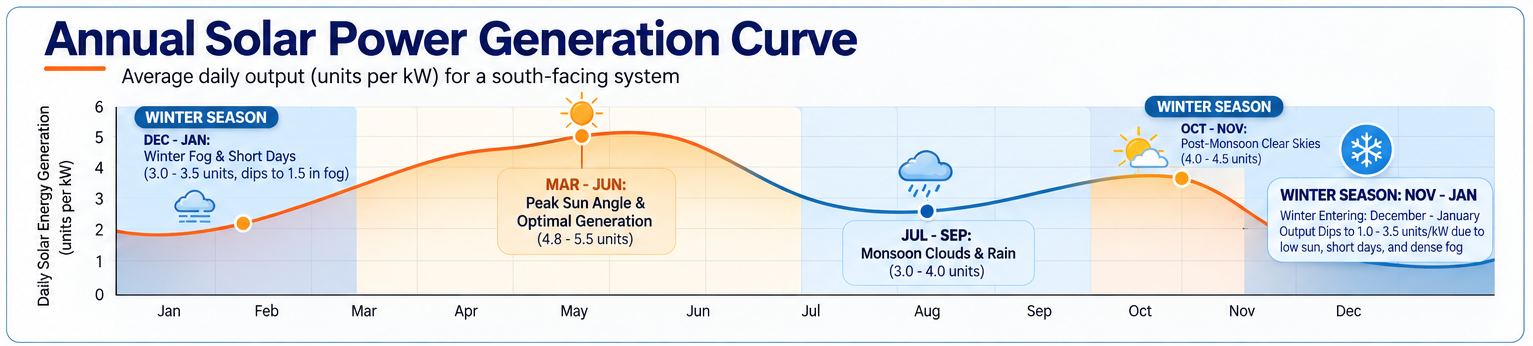
It sounds counterintuitive, but solar panels generally operate more efficiently at cooler temperatures. Solar panels convert sunlight into electricity. As conventional silicon panels heat up, their electrical output tends to decline. This is why panels operating under intense summer sunshine can become considerably hotter than the surrounding air and lose some efficiency.
In winter, cooler panel temperatures can reduce this temperature-related loss.
However, there is an important distinction: better efficiency does not necessarily mean more electricity generated over the day. A cold, clear winter day may be favourable for your panels. But if the day is short, foggy or hazy, the reduction in available sunlight can outweigh the benefit of cooler temperatures.
In other words, cold weather itself is not the problem. The amount of sunlight reaching your panels is often the more important factor.
|
Usually normal |
Worth investigating |
|
Gradual decline from November into January |
Output drops 30 percent or more on a clear day with no obvious cause |
|
Low output during fog, smog or rain |
Zero output on a sunny day |
|
Large day-to-day swings that match the weather |
Error codes or red or orange fault lights on the inverter |
|
Slightly lower output after a long dry, dusty spell |
One panel or string consistently far below identical neighbours |
|
Late start on foggy mornings |
Monitoring offline, or gaps in the data |
|
Clear-day peaks high for the season in February |
Several months in a row well below the installer’s estimate |
|
New afternoon shadows from the same tank or building |
A new shadow from something that has been added or has grown |
These are clues, not definitive diagnoses. Shading, inverter faults, wiring issues, grid interruptions and monitoring problems can all affect the figures you see.
Step 1: Check the weather. Was it foggy, hazy, cloudy or unusually overcast? Start by ruling out the most obvious explanation.
Step 2: Review daily generation. Look at the last seven to fourteen days rather than relying on a single reading. Check the total electricity generated each day, not just the peak output.
Step 3: Compare like with like. Compare clear days with other clear days from the same period, or with a reasonable winter estimate for your installation. Avoid using a summer day as your benchmark.
Step 4: Check your monitoring app. Look for inverter warnings, unexplained gaps in generation or recurring shutdowns. Remember that a monitoring or communications issue can sometimes make the displayed data incomplete.
Step 5: Contact your installer if the problem persists. Share the dates, generation readings, weather conditions and any error messages. This gives the service team a clearer starting point for diagnosing the issue.
Don’t open the inverter, disconnect electrical components or attempt rooftop electrical repairs yourself. Leave electrical checks to a qualified professional.
Horizon Renewable can help you assess your system’s generation patterns, review potential causes of underperformance, and understand what maintenance may be needed to keep your solar installation working reliably throughout the year.
Get in touch with our team to discuss your solar requirements. Call us at +91 9811121157 | 84482 95965