
“I’m planning to install solar. Should I get a battery too?”
It’s probably the question we are asked most often. The short answer? Maybe.
If someone tells you every home should have a battery, they are probably trying to sell you one. On the other hand, if someone says batteries never make financial sense, they are overlooking how quickly India’s electricity landscape is changing.
The truth lies somewhere in between.
For some homes and small businesses, a battery can significantly reduce dependence on the grid, provide reliable backup during power cuts, and make better use of the electricity generated by their solar panels. For others, especially those with a reliable power supply and favourable net-metering policies, it may make sense to wait.
So, how do you know which category you fall into?
Let’s start with the question that almost every homeowner asks.
It’s a fair question! When your rooftop solar system generates more electricity than your home is using, the extra power is exported to the electricity grid. This is called ‘Net Metering’ and most urban solar rooftop systems operate under this scheme.
At the end of your billing cycle, the electricity generated by your solar system is adjusted against the electricity you have consumed from the grid. In simple terms, the units you generate are deducted from the units you consume, and you pay only for the balance. For example, if your home consumes 900 units in a month and your solar system generates 700 units, your electricity bill will only be for the remaining 200 units. This is precisely why the case for storage is strong for off-grid or grid-constrained use cases, but genuinely unclear for a grid-connected home with good net metering.
“If I am already getting credit for my extra solar power, why would I spend more money on a battery?”
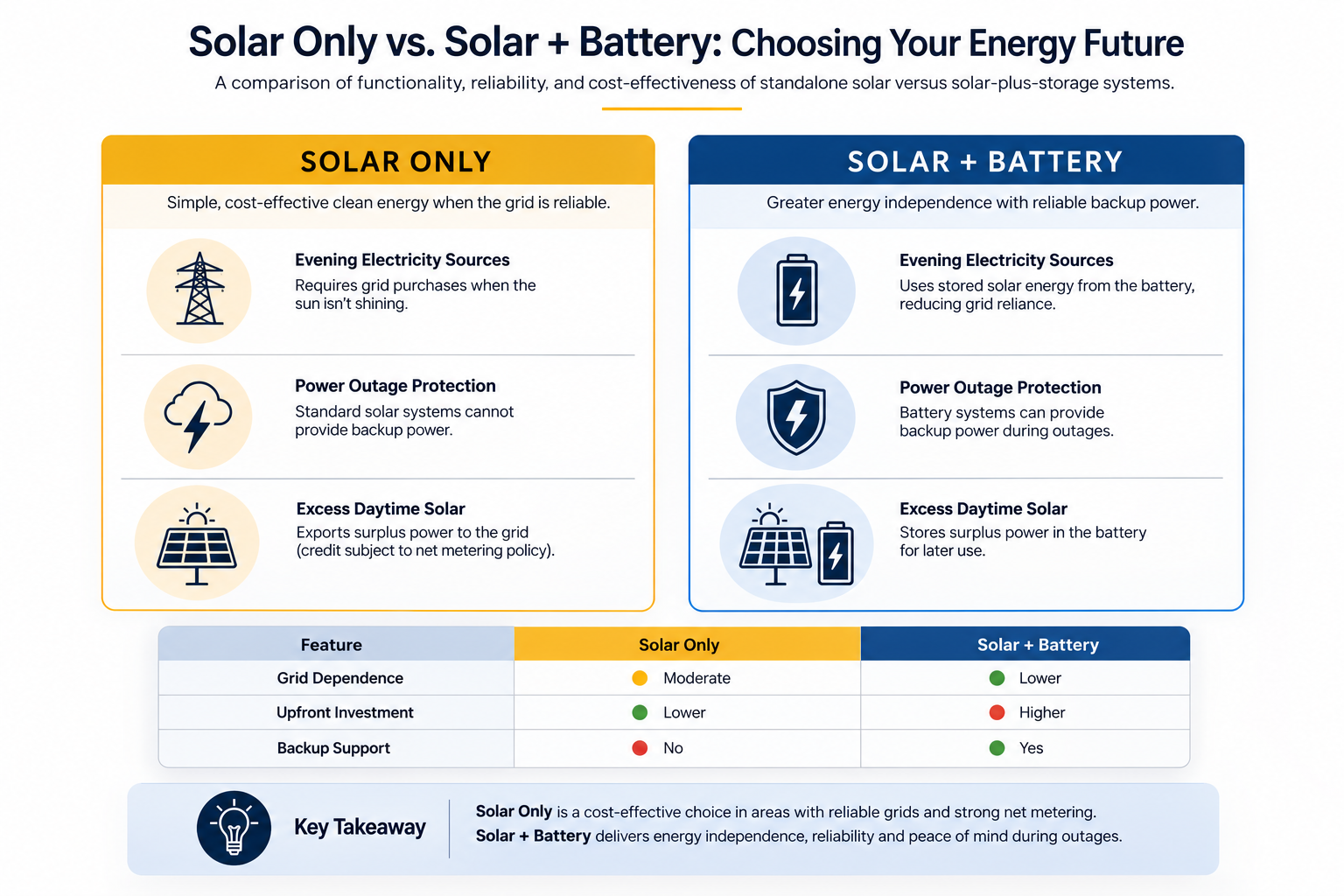
For many urban homeowners, the honest answer is you may not need one, at least not today. Under a generous, full-retail net metering arrangement, the grid effectively behaves like a free, unlimited battery: it “stores” your surplus energy and “returns” it to you later, with no upfront capital cost, no degradation, and no maintenance. In many cases, investing in a larger solar system delivers a better return than adding storage.
But that’s only part of the picture.
A battery isn’t just about reducing your electricity bill. It’s about what happens when the grid isn’t available, when your electricity use doesn’t match your solar generation, or when your energy needs change in the future.
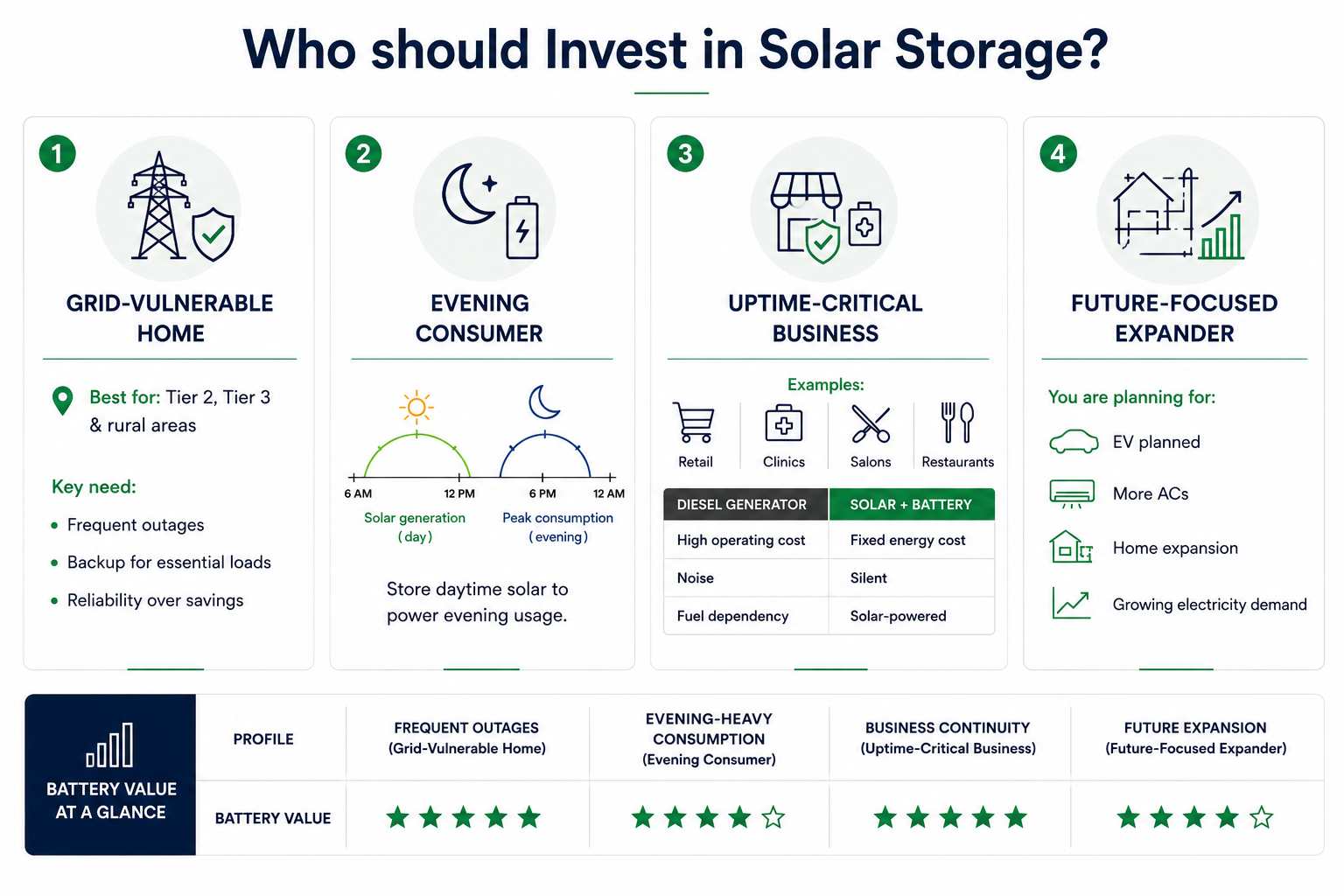
We have found that batteries make the most sense when they solve a real problem rather than simply add another piece of equipment.
If you live in a city or town where power cuts are frequent, the conversation changes completely. A solar system on its own won’t keep your home running during a grid outage. For safety reasons, standard grid-connected solar systems automatically shut down when the utility supply fails.
A battery changes that.
Instead of sitting in the dark waiting for power to return, your home can continue running essential appliances such as lights, fans, refrigerators, Wi-Fi, security systems, and even selected air conditioners, depending on the battery size.
However, you might wonder: how is this different from the inverter many homes already have?
Most Indian homes already have an inverter and battery that provide backup during power cuts. However, these systems are usually charged using electricity from the grid. A hybrid solar inverter works differently. It manages your solar panels, battery and grid connection together. During the day, it charges the battery using surplus solar energy whenever possible. During a power cut, it automatically switches to the battery so your essential appliances continue running. Once power returns, it seamlessly switches back to normal operation. If you are planning to add battery storage to your solar system, you’ll typically need a hybrid inverter rather than a standard on-grid inverter.
For many families in Tier 2 and Tier 3 cities or rural homes and farmhouses where outages are a regular part of life, the value of uninterrupted power often outweighs the savings alone.
Think about how your family uses electricity.
If everyone leaves home during the day and returns in the evening, chances are your biggest electricity consumption starts after the sun goes down. Air conditioners, televisions, washing machines, kitchen appliances, lighting, and EV charging all compete for electricity during the evening hours.
Without a battery, your home relies almost entirely on the grid during this period. With a battery, much of that demand can be met using the solar energy your roof generated earlier in the day.
The same principle applies to many small businesses.
Think about a petrol pump, restaurant, bakery, salon, at-home creche, or kirana store. For these businesses (especially micro enterprises run from homes), a power cut is more than an inconvenience. Many rely on diesel generators to bridge these outages, which is an expensive and noisy solution.
A solar-plus-storage system can reduce both grid dependence and generator use, helping businesses stay operational while lowering energy costs over time.
Maybe you’re planning to buy an electric vehicle. Perhaps you’re adding another floor to your home, installing more air conditioners, or building a home office.
Your electricity consumption is likely to increase over the next five to ten years. Planning your solar system so it is battery-ready or adding storage now can make future expansion much simpler.
Note: What’s Subsidised and What Isn’t. Solar is subsidised. Storage generally is not. Under India’s central rooftop solar scheme, the Central Financial Assistance offers ₹78,000 for a 3 kW system (plus state subsidy where applicable) or larger. This subsidy applies to the solar panels and inverter, but it does not subsidise batteries. For now, a residential or small-business battery purchase in India should be evaluated at its full sticker price.
It’s also worth remembering that adding battery storage isn’t just about buying a battery. Most homes with standard on-grid solar systems will also need a hybrid inverter to manage the solar panels, battery and grid connection together. This is one of the reasons a solar-plus-storage system costs more than a conventional rooftop solar installation.
Imagine a family of five living in a 3,000 sq. ft. villa. They have four air conditioners, a refrigerator, a washing machine, geysers, televisions, kitchen appliances, and a home office. Their monthly electricity bill before installing solar is around ₹18,000 to 22,000.
Here’s what their energy profile might look like.
|
Home Profile |
|
|
Rooftop Solar |
10 kW |
|
Average Monthly Consumption |
1,400–1,600 units |
|
Average Solar Generation |
1,250–1,450 units/month* |
|
Peak Electricity Use |
6 PM – 11 PM |
|
Power Cuts |
Occasional |
*Actual generation varies by location and season.
The family uses solar power throughout the day. Any excess electricity is exported to the grid under net metering. In the evening, when everyone comes home, air conditioners, lights, televisions, and kitchen appliances increase electricity demand. Since solar panels are no longer generating power, the home draws electricity from the grid.
The result:
✅ Lower electricity bills than before solar.
✅ Good savings through net metering.
❌ No backup during power cuts.
❌ Evening consumption still depends on the grid.
Now imagine the same home with a 10 kW solar system and a 20 kWh battery, designed to provide around 2 hours of backup for essential evening loads. Instead of exporting all the extra solar power generated during the afternoon, part of it is stored in the battery. If there’s a power cut in the evening, or if the family wants to reduce its dependence on the grid, the battery can power selected appliances such as:
For most homes, that’s enough to comfortably ride through the majority of short power cuts without needing a diesel generator or inverter.
A quick note: A residential battery is not usually designed to power your entire home through the night. Instead, it’s typically sized to keep essential appliances running during outages or to shift a few hours of solar energy into the evening, helping you make better use of the electricity your solar panels generate.
The result:
✅ Greater use of self-generated solar power
✅ Backup during short power cuts
✅ Lower dependence on the grid during evening hours
✅ A system that’s ready for future expansion if electricity needs grow
A battery backup system isn’t just the battery itself. It also requires a hybrid inverter and additional installation work. The table below shows an indicative cost comparison for a typical 6 kW residential solar system.
| Component | On-Grid Solar | Hybrid (2-Hour Backup) | Hybrid (3-Hour Backup) | Hybrid (5-Hour Backup) |
|---|---|---|---|---|
| Solar PV System (6 kW) | ₹3,80,000 | ₹3,80,000 | ₹3,80,000 | ₹3,80,000 |
| Installation & Integration | ₹19,000 | ₹24,750 | ₹25,875 | ₹28,125 |
| Battery | – | ₹1,37,500 | ₹1,64,286 | ₹2,08,333 |
| Hybrid Inverter (Single Phase)* | ₹30,000 | ₹70,000 | ₹70,000 | ₹70,000 |
| Hybrid Inverter (Three Phase)* | ₹50,000 | ₹1,00,000 | ₹1,00,000 | ₹1,00,000 |
| Indicative Total | ₹3.80 lakh | ₹5.50 lakh | ₹5.75 lakh | ₹6.25 lakh |
*The inverter cost depends on whether your home has a single-phase or three-phase electricity connection.
** Actual backup time depends on which appliances are running, battery capacity, and state of charge. Running multiple air conditioners or other high-power appliances will reduce the available backup time.
When you add battery storage, you are not just buying a battery. A hybrid solar system typically includes:
This is why adding around 2 hours of battery backup typically increases the cost of a 6 kW residential solar system by around ₹1.7 lakh compared to a standard on-grid installation.
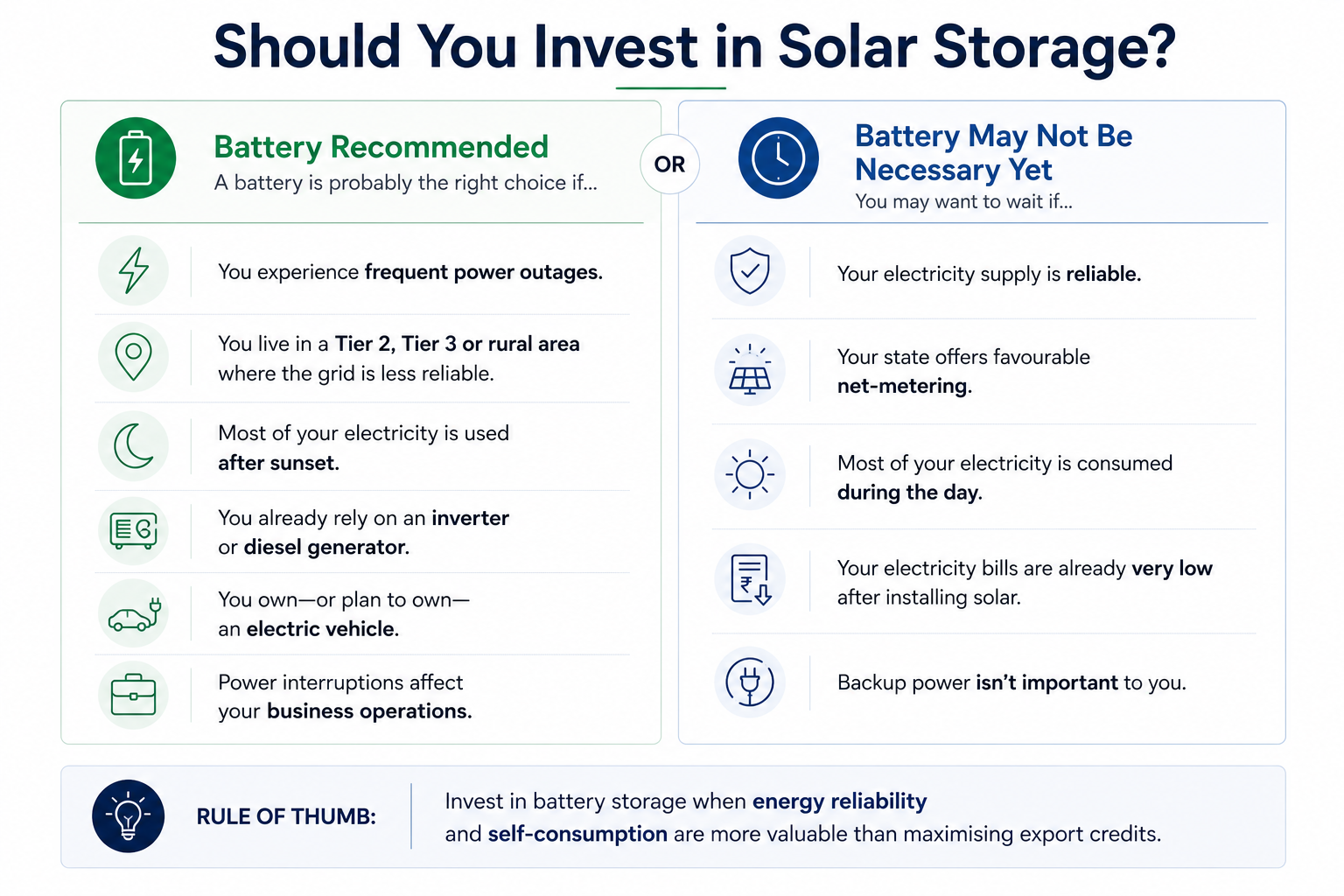
If we were advising a friend rather than making a sales pitch, we would say this: Don’t buy a battery simply because it’s the latest trend. Buy one if it solves a problem you actually have.
For many homes in metro cities with reliable electricity and favourable net metering, solar panels alone continue to offer excellent value. But for families dealing with regular power cuts, growing evening electricity use, electric vehicles, or businesses where downtime costs money, battery storage can provide benefits that go well beyond lower electricity bills.
The best solution isn’t the most expensive one. It’s the one that’s designed around how you live and work.
That’s why every recommendation at Horizon starts with understanding your electricity bills, your energy usage and your goals, not with selling you the biggest battery we can.