

If you have spoken to a solar EPC in the last few months and felt like the quote was higher than what you expected six months ago, you’re not imagining it. You’re seeing the real-world effect of a policy called ALMM (the Approved List of Models and Manufacturers) tightening at exactly the moment industrial and commercial demand for solar is at its highest.
With the implementation of the Approved List of Models and Manufacturers (ALMM) and the government’s push toward domestically manufactured cells and modules, project costs have risen, procurement timelines have become more complicated, and businesses are finding that quotations they received a few months ago no longer reflect today’s reality.
For some companies, the immediate reaction has been to delay investment and wait for prices to fall. But looking at solar purely through the lens of upfront cost misses the larger picture.
This article breaks down what ALMM actually is, why it’s pushing up costs, what that means in real rupees for businesses, and despite the higher upfront number, why solar still makes overwhelming financial sense. We will also cover what you can do about the cost increase, because there are real, practical levers available, not just “wait and see.”
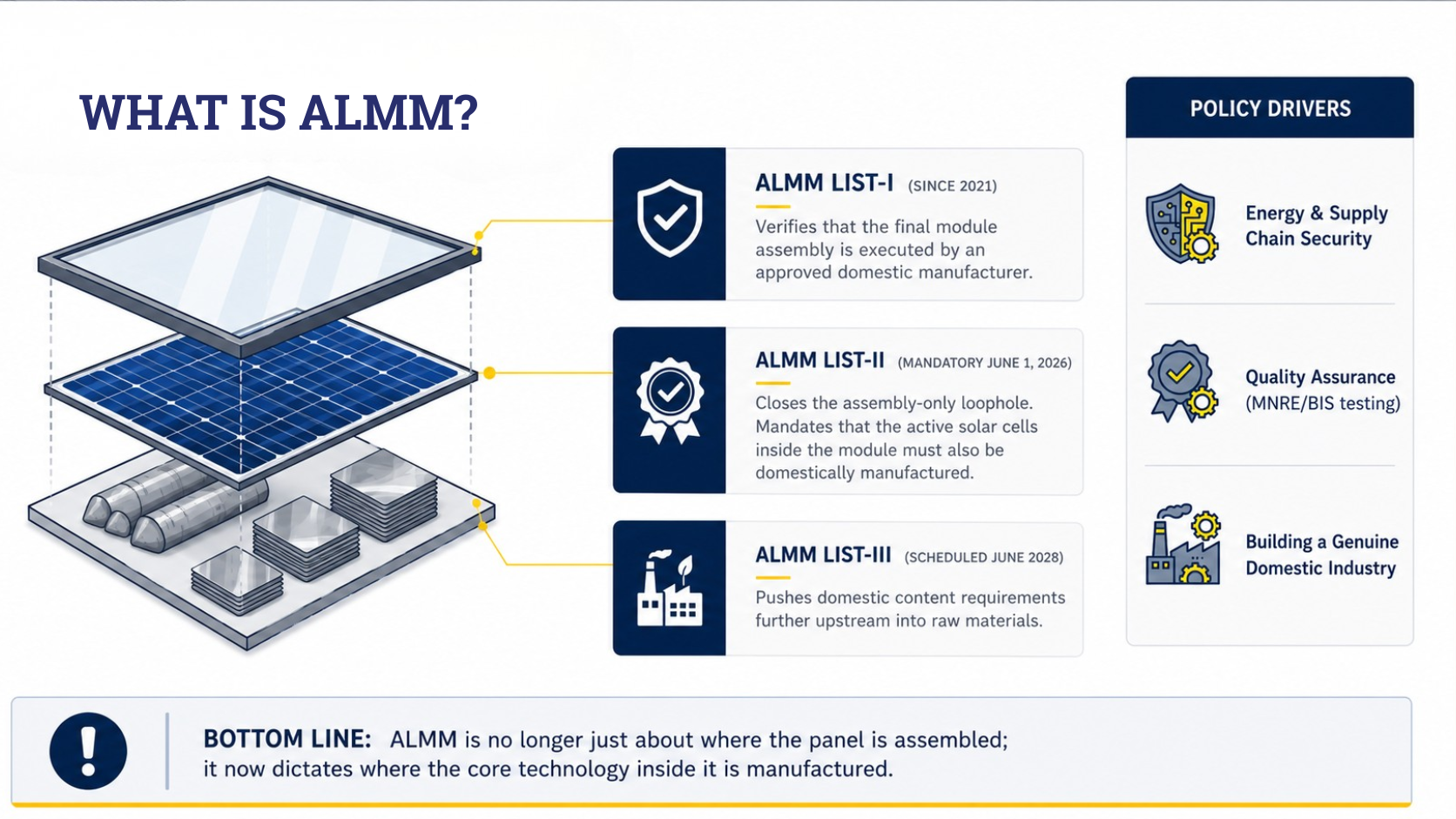
The Approved List of Models and Manufacturers was introduced by the Ministry of New and Renewable Energy to ensure that solar projects use products manufactured by approved suppliers that meet prescribed quality standards. Initially, the focus was on modules. But the scope of the policy has steadily expanded. With the introduction of ALMM List-II and the growing emphasis on domestically manufactured cells, the government is attempting to localize a larger share of the solar value chain. ALMM was first introduced in 2019 and has grown in scope since:
The critical date for most businesses right now is June 1, 2026, the day List-II became mandatory. MNRE confirmed this deadline would hold despite industry requests for an extension, with only narrow, case-by-case relief for projects that had already installed modules or made significant on-ground progress before that date.
For any project that is mandated to use ALMM, net-metering connections, open-access power projects, and anything tied to a government scheme or subsidy, modules must now come from List I, and the cells inside those modules must come from List II.
It isn’t an arbitrary cost-raising exercise. The logic is straightforward industrial policy:
Viewed from a national perspective, the strategy makes sense. But transitions rarely happen without friction, and that friction is being felt most acutely by commercial and industrial consumers.
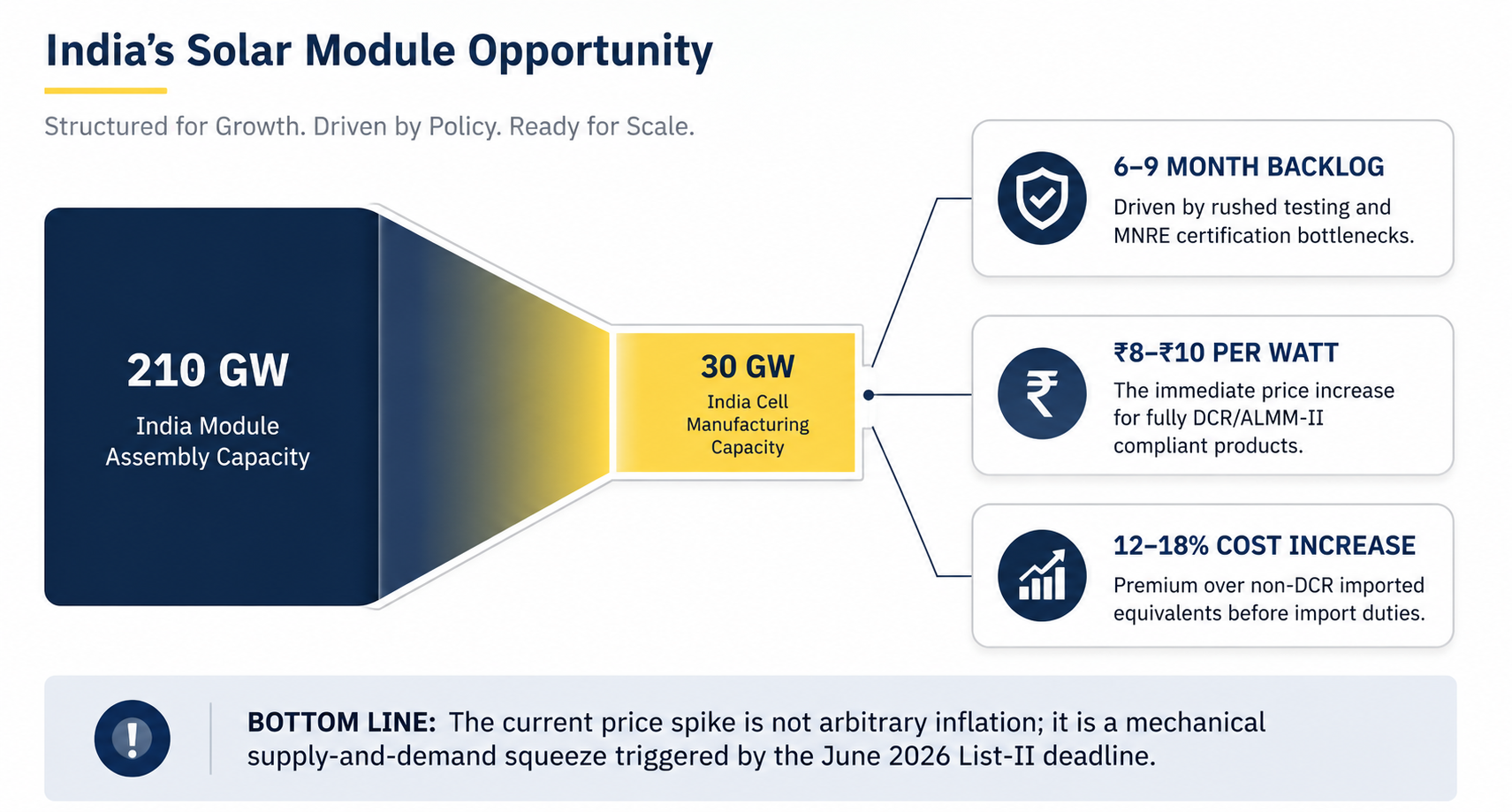
The core problem: demand has outrun supply. This is the single most important number to understand: India’s domestic solar cell manufacturing capacity is roughly 30 GW per year, while India’s module capacity is 210 GW. ALMM List-II forces every compliant module to draw from that much smaller 30 GW cell pool. The result is a straightforward supply squeeze.
Industry bodies asked MNRE for a phased rollout (proposing an extension to October 2026) specifically because they could see this mismatch coming. MNRE held firm on the June 1, 2026 date, offering only case-by-case relief for projects already at an advanced stage.
Procurement: fewer suppliers, more verification work. Every module has to be checked at two levels: is the module on List-I, and is the cell inside it on List-II? Verification has to happen model-by-model, not just brand-by-brand, because ALMM listings are specific to exact product variants and can change between revisions. Procurement teams now need active compliance tracking just to avoid getting caught out by a list update mid-project.
Time delay: With every manufacturer rushing to get cells and modules tested and listed before and after the deadline, testing and certification agencies are facing a genuine bottleneck. Industry estimates point to certification delays of six to nine months in some cases.
Cost: Multiple industry pricing trackers in 2026 show DCR-compliant (domestically-sourced cell + module) panels carrying a meaningful premium over non-DCR equivalents:
At a project level, this routinely shifts total turnkey cost by lakhs of rupees on a mid-sized rooftop plant, and tens of lakhs to over a crore on a multi-megawatt installation.
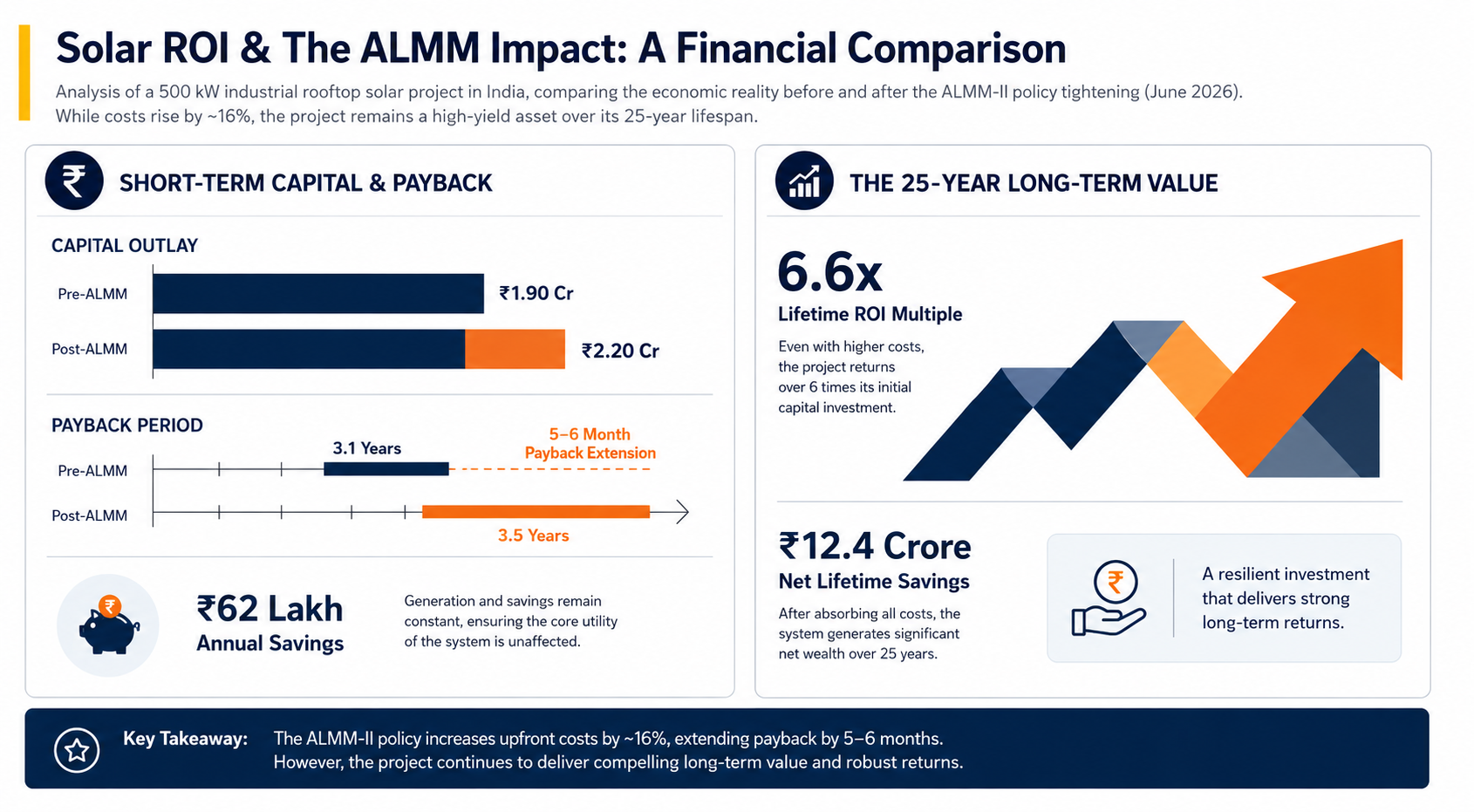
Let’s put real numbers against a real-sized project; a 500 kW rooftop solar installation, the kind of system a mid-sized factory, warehouse, or industrial unit in India would typically install to offset its grid electricity bill.
(Note: the figures below are illustrative, built from current industry pricing ranges, and should be validated against your own EPC quotation. Horizon’s team will run exact numbers for your specific site, tariff, and roof condition.)
|
Before ALMM-II tightening |
After ALMM-II tightening (June 2026 onward) |
|
|
All-in turnkey cost per watt |
~₹38/W |
~₹44/W |
|
Total project cost (500 kW) |
₹1.90 Crore |
₹2.20 Crore |
|
Extra cost from compliance |
— |
₹30 lakh (≈16% increase) |
That ₹30 lakh isn’t a rounding error. For a mid-sized industrial unit, that’s a meaningful capital outlay decision, and it’s exactly why business owners are hesitating right now.
|
Before |
After |
|
|
Annual generation (500 kW, ~1,550 kWh/kWp/yr) |
7,75,000 kWh |
7,75,000 kWh |
|
Annual savings at ₹8/unit grid tariff |
₹62 lakh |
₹62 lakh |
|
Simple payback period |
~3.1 years |
~3.5 years |
The honest takeaway: the ALMM-driven price increase stretches your payback period by roughly 5 to 6 months, not years. That’s a real cost, but it’s far short of derailing the investment case.
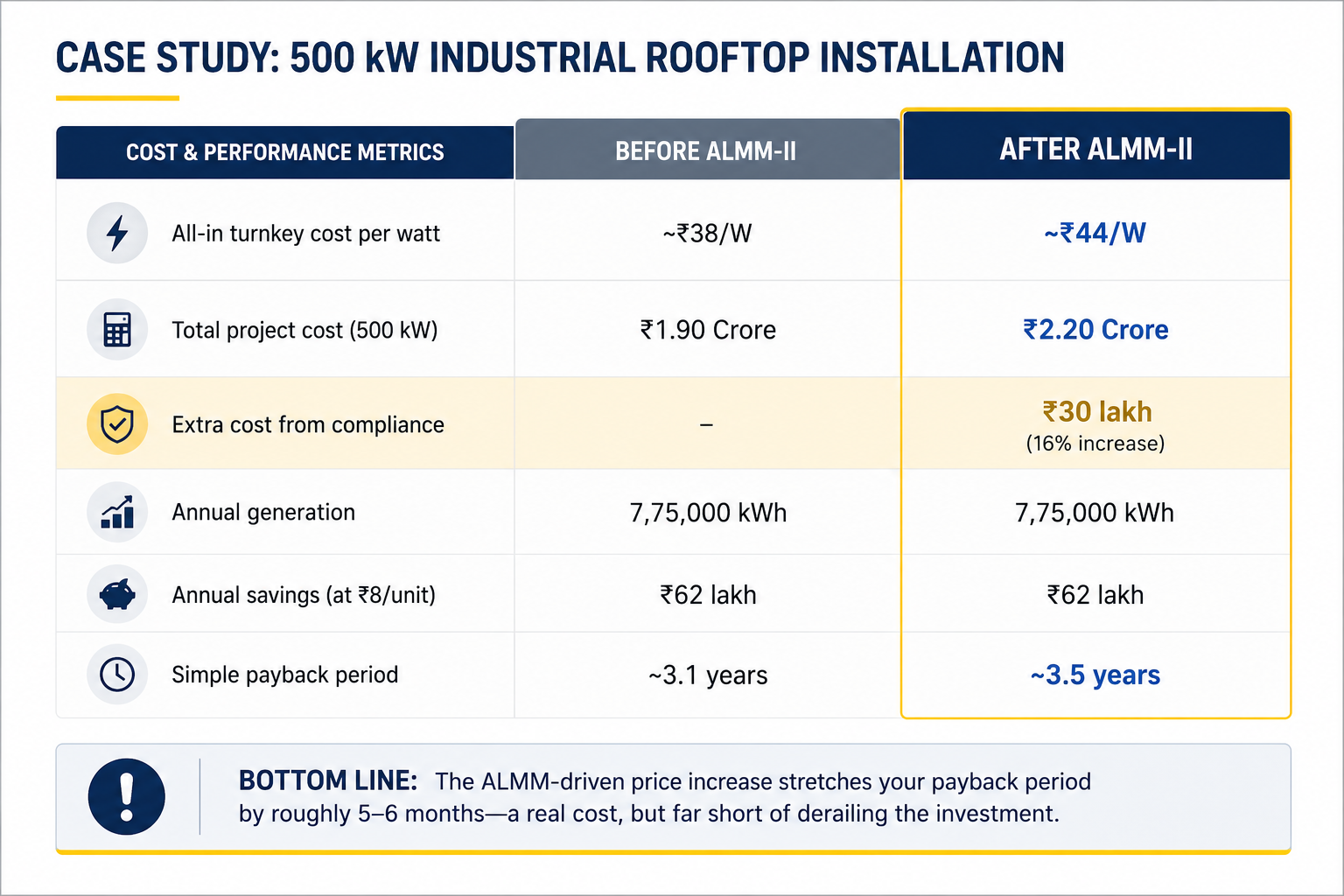
With module degradation of around 0.5% per year, and no fuel costs, the same 500 kW system over its full life (conservatively assuming your grid tariff never rises a single rupee over 25 years, which it almost certainly will):
|
Before |
After |
|
|
Total capex |
₹1.90 Cr |
₹2.20 Cr |
|
Lifetime gross savings (25 yrs, flat tariff) |
₹14.6 Cr |
₹14.6 Cr |
|
Net lifetime savings |
₹12.7 Cr |
₹12.4 Cr |
|
ROI multiple (savings ÷ capex) |
7.7x |
6.6x |
Even absorbing the full ALMM-driven cost increase, this project still returns more than 6 times its capital cost over its lifetime, on conservative, flat-tariff assumptions. If your grid tariff rises even modestly over 25 years, the real multiple is higher still.
The policy makes solar more expensive to install, but it does not make solar a bad investment. It moves the breakeven point from just over 3 years to just under 3.6 years, on an asset that then keeps paying you for another two decades.
You can’t change MNRE policy, and waiting for prices to come back down isn’t a reliable strategy. Domestic cell capacity will scale up over the coming years, but in the near term, demand from the mandatory deadline is, if anything, pushing prices up further, not down. So the real question is: how do you absorb or restructure the extra cost rather than letting it stall your decision?
We guarantee quality, not just compliance. Every module we specify is verified against the current ALMM List-I and List-II at the time of procurement. With list revisions happening multiple times a year, that distinction matters.
We help you finance the gap. Through our banking partners, we structure financing so the ALMM-driven cost increase becomes a manageable EMI.
We show you exactly what your money buys. Our 3D modelling process maps your actual site, your actual roof, and your actual load profile before a single rupee is committed. You see precisely how many watts of capacity, what generation profile, and what payback period your specific investment produces.
We protect the ROI we promise you, for the life of the plant. A solar plant’s 25-year return depends on it actually being maintained at the performance level it was designed for. We don’t disappear after commissioning; ongoing operations and maintenance keep your plant in tip top condition.
Yes, the policy environment has made solar more expensive. But, it has not made solar a worse investment! The underlying math, even in our conservative case study, still returns more than six times its capital cost over its lifetime. The businesses that come out ahead are the ones that treat the ALMM increase as a financing and planning problem to be solved, not a reason to wait.
If you want to see what these numbers look like for your specific facility, get in touch with Horizon Renewable Power for a free site assessment and a transparent, ALMM-compliant proposal – to the rupee and the watt.