

For most industrial and commercial (C&I) leaders, solar energy is still framed as a cost-saving initiative—an operational decision driven by tariffs and payback periods. That framing is incomplete.
In 2026, solar is fundamentally a regulatory asset class. With solar investment, a business’s Internal Rate of Return (IRR) is shaped less by sunlight and more by state-level policy shifts, DISCOM (Distribution Company) behaviour, and evolving compliance mandates. Two identical factories in Rajasthan and Haryana will see dramatically different ROIs—not because of the weather, but because of the legal architecture.
At the center of solar power regulations lies the Electricity Act, 2003, which liberalized generation and enabled open access, effectively allowing private players to generate and procure power outside traditional utility monopolies. The act includes provisions for preferential tariffs and quotas to encourage the adoption of renewable energy. Mandatory procurement of renewable energy for distribution licensees and facilitation of grid connectivity were incorporated.
National Tariff Policy 2006 includes the Renewable Purchase Obligation (RPO) to fix the minimum percentage of procurement of energy consumption by the state governments. The central and state electricity regulatory commissions must purchase a certain percentage of grid-based power from renewable sources. Solar power is to comprise 8% of power purchases by states by 2022. It also lays out the regulations for open access.
In October 2025, the Draft Electricity (Amendment) Bill, 2025 was released for public feedback, and it proposes a penalty for non-compliance with RPO. The penalty for non-compliance will range from 35 paise to 45 paise per unit of electricity purchased.
The original National Electricity Policy 2005 version was light on solar power and only spoke in passing about using solar energy as solar water heating systems and solar passive architecture to promote energy conservation. However, the 2026 draft of the National Electricity Policy sets out concrete steps to promote and utilize solar power. The draft policy sets out time-bound goals for solarizing agricultural activities, consumer-driven peer-to-peer (P2P) energy trading, pricing, investment guidance, and more.
Together, these policies transformed solar from an alternative to a compliance-driven necessity.
While there are multiple variations, most commercial and industrial solar adoption in India falls into four broad models.
Captive solar is often the most straightforward to understand. The consumer owns a significant stake (at least 26%) of the equity shares and consumes the majority of the power produced (at least 51%), as specified under Rule 3 of the Electricity Rules, 2005.
For many large industrial players, this model offers a sense of control over both the asset and long-term energy costs, such as the 125 MWp solar plant in Nagpur by CtrlS datacenters. Captive solar also allows companies to bypass several grid-related charges that apply to third-party procurement.
However, this control comes with regulatory expectations. Captive structures must comply with ownership and consumption thresholds, and these are increasingly scrutinized. The recently introduced Electricity (Amendment) Rules, 2026, have made captive solar easier for businesses by clarifying ownership provisions, simplifying rules for group captive arrangements, and establishing a clear verification mechanism. A new provision has been added to avoid imposition of charges on the captive consumers by the Distribution licensees pending verification of the captive status.
For businesses with stable, predictable energy demand and the ability to invest in or co-invest in generation assets, captive solar remains one of the most attractive pathways. But it requires discipline in structuring and compliance, not just capital.
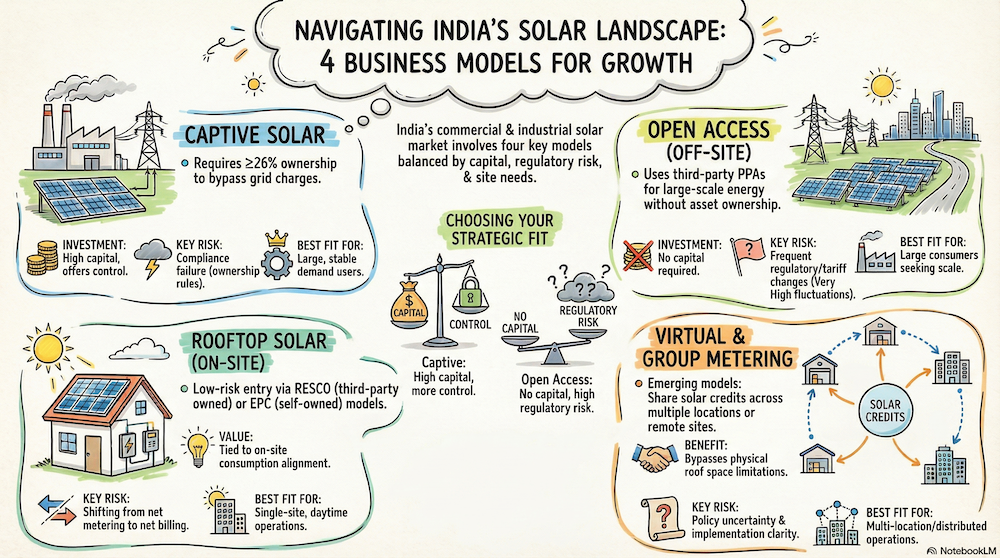
Open access has emerged as one of the most powerful mechanisms for large-scale solar adoption.
Under this model, a business procures power from a third-party solar developer, often through long-term power purchase agreements (PPAs). The electricity is generated off-site and transmitted through the grid to the consumer.
The appeal is clear: access to large solar capacities without owning the asset, and of course, it is more cost-effective as open access solar tariffs in India are often lower than industrial grid tariffs.
But open access is also where regulation becomes most visible. Most additional charges, such as cross-subsidy surcharges, wheeling charges, and banking fees, vary widely across states and are unpredictable. Regulatory revisions can alter cost structures mid-project, affecting long-term returns.
For large consumers with high and consistent energy demand, open access remains a compelling option, but it can be impacted by regulatory changes.
Rooftop solar has two models – RESCO (Third party owned/OPEX) and EPC (Self owned/CAPEX). Rooftop solar plants, especially under the RESCO model, has gained traction among businesses looking for a low-risk entry into solar.
In this structure, a third-party developer installs and owns the system on the consumer’s premises, and the consumer pays for the electricity generated, typically at a tariff lower than grid power. The EPC structure requires a bigger investment from the business; however, a large chunk of the cost can be financed by a bank and it has the clear advantage of complete ownership.
Rooftop solar has clear financial benefits, quick IRR, and the peace of mind provided by a tested technology stack; however, it is deeply tied to net metering or net billing regulations, which determine how excess power exported to the grid is valued.
Across several states, regulatory frameworks are evolving from net metering, where exports offset consumption, to net billing, where exported energy is compensated differently.
This shift makes consumption alignment increasingly important. Rooftop systems tend to deliver the strongest value when generation closely matches on-site demand, particularly during daytime operations. As a result, rooftop solar remains highly effective for facilities with strong daytime loads and businesses seeking a quick, low-risk, and simple solar solution.
One of the most significant regulatory evolutions in India’s solar landscape is the emergence of virtual and group net metering.
These models are designed to solve a fundamental limitation of rooftop solar: not every business has the right kind of roof, or sufficient space, to install solar.
Virtual Net Metering
Under virtual net metering, a single solar plant can serve multiple consumers. The energy generated is virtually allocated across different users, allowing them to benefit from solar without hosting the system on-site.
Group Net Metering
This model allows a single entity to distribute solar generation across multiple electricity connections, particularly useful for companies with operations spread across locations.
Virtual Net Metering (VNM) and Group Net Metering (GNM) both allow sharing solar credits from a single plant, but differ in user structure. VNM allows multiple, independent consumers (like apartment residents) to share a remote plant, while GNM applies to a single entity with multiple, connected accounts (like one company with multiple offices).
Together, these frameworks are expanding access to solar in meaningful ways:
For businesses with distributed operations, these emerging models offer a way to optimize solar at a portfolio level, rather than at an individual site level.
As businesses begin to optimize not just how they generate solar power but how they use it, Battery Energy Storage Systems (BESS) are emerging as a critical strategic layer.
BESS is essential for storing excess solar/wind energy during the day for usage during peak demand hours, offering grid stabilization. But in India’s regulatory context, its real value lies in decoupling generation from consumption, giving businesses control over when and how energy is used.
Between 2022 and 2032, India plans to add over 47 GW of battery storage capacity, with a total investment of around ₹3.5 lakh crore. Projects are accelerating due to falling battery costs and government incentives. This has led to the emergence of new models such as “Battery as a Service” (BaaS) and “Storage as a Service” (SaaS), which allow users to avoid high upfront costs.
BESS becomes particularly important as regulatory frameworks evolve.
In rooftop solar, as net billing gradually replaces net metering, exporting excess energy is becoming less valuable. Storage allows that energy to be retained and used during evening or peak tariff periods, improving overall savings.
In captive setups, BESS enhances self-consumption, especially for industries with continuous or multi-shift operations. Instead of relying on grid power after sunset, stored solar energy can bridge the gap, extending the utility of the solar asset.
For open access users, storage adds a new layer of flexibility. It can help manage generation variability, reduce reliance on banking mechanisms, and optimize consumption during high-cost periods.
Even in emerging models like virtual and group net metering, while integration is still evolving, storage is expected to play a role in enabling more predictable and balanced energy allocation across distributed consumption points.
That said, BESS adoption today is still selective. Its financial viability depends on:
There is no single “best” solar model in India. Instead, the right choice depends on a combination of:
A large manufacturing plant with stable demand may benefit from captive or open access structures. A distributed logistics network may find greater value in virtual or group net metering. An SME may prefer the simplicity of a rooftop RESCO/EPC model.
Increasingly, the most effective strategies are not singular; they are hybrid. Companies are combining rooftop solar with open access for scale and exploring emerging models for distributed loads. This portfolio approach allows businesses to balance risk, optimize costs, and adapt to regulatory shifts.
Here’s an overview of the features and advantages of all 4 models:
Parameter | Captive Solar | Open Access Solar | Rooftop Solar (RESCO/EPC) | Virtual / Group Net Metering |
Ownership | Partial ownership (≥26%) of equity shares | Third-party owned | Third-party owned (RESCO) or self-owned (EPC) | Typically third-party or centralized asset |
Power Source Location | Off-site (usually) | Off-site | On-site (your facility) | Off-site, virtually allocated |
Capital Investment | Moderate to high (equity required) | None | None (RESCO) / Moderate (EPC) | Low to moderate (depends on structure) |
Key Charges Applicable | Limited (if compliant captive) | Multiple (CSS, wheeling, banking) | Minimal | Depends on state regulations |
Policy Sensitivity | Medium (compliance scrutiny) | Very high (frequent changes) | High (net metering → net billing shift) | High (policy still evolving) |
Best Fit For | Large, stable demand users | Large energy consumers seeking scale | Single-site, daytime-heavy consumption | Multi-location or distributed operations |
Scalability | High | Very high | Limited by rooftop size | High (portfolio-level allocation) |
Execution Complexity | Moderate | High | Low | Moderate |
Key Risk | Compliance failure (ownership/consumption rules) | Regulatory changes impacting costs | Reduced export value | Policy uncertainty / implementation clarity |
India’s solar market is entering a new phase. The early years were defined by incentives and rapid adoption. The next phase will be defined by:
At the same time, innovation in business models, particularly around distributed solar and BESS, will continue to expand access and flexibility.
The companies that will succeed in India’s solar transition will not necessarily be those that install the most capacity. They will be the ones who choose the right model, in the right location, at the right time, and adapt as regulation evolves.
At Horizon, we partner with businesses to move beyond one-off installations toward integrated, regulation-aware energy strategies that evolve with the market. We work with C&I consumers to:
If you’re thinking about solar not just as a project, but as a long-term capability, it’s worth starting that conversation early.