
India is a very price-sensitive market, so it came as no surprise when almost every inquiry, lead, and meeting included questions about pricing. The subtext was clear: every buyer wanted to know “Who will give me the lowest quote?”
For those of us in the solar business, we often see the cost of cheap solar, and we strongly feel that buyers – especially C&I ones – must understand that in the long run, what you save upfront you often lose over time.
Solar plants run for 25+ years; that’s more than all the big-ticket buys in your home put together, including your car. Even in factories, capital assets seldom have such a long life. When an asset is expected to perform for decades, the decision cannot be driven by upfront cost alone.
Instead of asking about price, a more relevant question would be, “Who will give me the best-performing system over its full lifetime?”
At present, most commercial and industrial owners base their decision on ₹/W cost, a metric that captures only upfront investment. But solar is not a one-time purchase. It is a long-term energy system. Which means the metric that actually matters is not ₹/W but Levelized Cost of Energy (LCOE), the cost per unit of electricity generated over the system’s lifetime.
For a dynamic electrical system operating for 25+ years, performance depends on design precision, component behaviour, and long-term system integrity.
In 2026, solar is fundamentally a regulatory asset class. With solar investment, a business’s Internal Rate of Return (IRR) is shaped less by sunlight and more by state-level policy shifts, DISCOM (Distribution Company) behaviour, and evolving compliance mandates. Two identical factories in Rajasthan and Haryana will see dramatically different ROIs—not because of the weather, but because of the legal architecture.
Price-conscious buyers often focus on the installation quote. The more useful number to examine is the cost per unit of electricity generated over 25 years, which is the Levelized Cost of Energy (LCOE).
Horizon’s own ROI modelling across commercial system sizes illustrates this clearly:
|
System Size (kWp) |
Payback Period |
Cost/Unit (25 yrs) |
Tariff in 25 yrs (YoY 2%) |
|
50 kWp |
4-5 years |
₹0.74 |
₹12.30 |
|
200 kWp |
4-5 years |
₹0.86 |
₹12.30 |
|
500 kWp |
4-5 years |
₹1.13 |
₹12.30 |
Source: Horizon Renewable Power ROI modelling. Based on standard assumptions, including 4.68–4.93 kWh/kWp/day generation (in regions with higher radiation levels) and ₹6.50/unit current tariff.
INSIGHT – At ₹1.13 per unit over 25 years (for a 500 kWp system), versus a projected grid tariff of ₹12.30 per unit, solar delivers electricity at approximately one-twelfth the cost of grid power. That margin is only achievable if the system performs as designed, every year, for 25 years.
Consider the numbers with LCOE (Total Lifetime Cost / Total Energy Generated). A ₹2/W increase in capex leads to ~₹0.04/unit increase over lifecycle, but a 25–30% drop in generation results in a 25–40% increase in effective cost per unit!
INSIGHT – Solar ROI is far more sensitive to performance loss than to upfront cost. This is where engineering quality becomes the dominant variable.
Solar performance is often misunderstood as a function of panels and sunlight. In reality, it is the outcome of three interacting layers:
Even small inefficiencies in each layer can combine to reduce output by 20–40% over time.
The design phase determines how efficiently a system can convert available irradiance into usable energy. During this phase 3 things are critical to ensure correct plant design:
Solar panels are connected in series to form “strings,” and the performance of each string is limited by its weakest panel. If even one panel in the string underperforms, due to shading, dirt, or electrical mismatch, the entire string’s output drops. This is why correct string sizing and uniformity are critical. Mixing panels with different wattages or electrical characteristics, or designing strings that don’t align with the inverter’s range, impacts generation.
Solar systems are highly sensitive to even small shadows from parapet walls, water tanks, or nearby buildings, and inadequate shadow analysis is one of the most common technical gaps in installations.
Without 3D simulation, you can end up with a design that has suboptimal row spacing, seasonal shading, and rooftop obstructions. A single shaded module can reduce string output by up to 30–50%, and over time, repeated partial shading can also create hotspots, reducing the lifespan of modules.
Maximizing the number of panels on a roof does not always maximize energy generation.
If panels are placed too close together, they begin to cast shadows on each other, and tight layouts can also reduce airflow, increasing panel temperatures and lowering efficiency. Good design balances capacity with spacing, tilt, and orientation to ensure consistent performance throughout the day and across seasons.
Solar components are rated under standard test conditions (25°C, controlled irradiance). Real-world rooftop conditions in India are far more demanding.
All panels degrade over time, but the rate of degradation is the critical differentiator. Premium monocrystalline panels degrade at 0.3–0.5% per year, meaning that at the end of a 25-year lifespan, a quality panel retains over 90% of its original output.
Lower-quality panels degrade at 1% per year or more. That translates to operating at 75% capacity or below after 25 years. For a 200 kW commercial system, that degradation gap represents crores of rupees in lost electricity value over the asset’s lifetime.
The inverter is the heart of a solar system and its most failure-prone component. A study conducted by MDPI, showed that the inverter is the component most frequently reported as a source of technical problems (54%). Budget inverters typically require replacement within 7–10 years. Premium inverters are built to last 12–15 years.
For a commercial installation, one unplanned inverter replacement during the asset’s life can cost ₹200,000–₹5,00,000 (for a 100 kW system) or more, erasing years of savings in a single event. Beyond replacement cost, a failing inverter can produce voltage fluctuations that damage other connected industrial equipment.
The panels and inverter are visible and often compared. What is overlooked is the Balance of System: mounting structures, DC cabling, earthing, conduits, surge protection devices, and junction boxes. While it is critical to ensure these are of good quality, even top-quality components can underperform if execution is compromised.
Much of this comes down to how carefully electrical and structural details are executed on site. For instance, DC cabling must be properly sized and routed; undersized cables increase resistive losses, while poor terminations can lead to heating, arcing, and even fire hazards.
Loose or exposed wiring, especially without protective conduits, is one of the most common causes of both efficiency loss and long-term risk. Equally critical is the earthing and protection system. A safe system has separate earthing for DC, AC, and lightning protection, along with surge protection devices (SPDs). Without these, the system, particularly the inverter, is vulnerable to electrical surges.
Structural integration also plays a key role. Improper waterproofing or careless rooftop penetrations can cause water seepage, damaging both the building and the electrical system over time. Additionally, substandard mounting structures can cause panel misalignment, reducing efficiency and damaging the roof.
Maintenance is not an afterthought in solar; it is a core dimension of system quality. Unlike most equipment, solar systems do not fail suddenly; they degrade gradually, and that degradation directly impacts energy output over time.
Factors such as dust accumulation can reduce generation by 2–15%, depending on the environment. Additionally, thermal losses from rising module temperatures can reduce efficiency by about 0.4–0.5% per degree increase.
More critically, in the absence of proper monitoring, small faults often go undetected, allowing performance losses to accumulate. Without a structured operations and maintenance (O&M) strategy, covering regular cleaning, system checks, and real-time monitoring, these small losses can multiply.
The consequences of prioritising price over quality are not theoretical. Horizon Renewable Power’s audit and restoration team encountered a textbook example at a Caffeine and Tea Exporter* factory in Bagru, Rajasthan, in January 2026.
The Situation: The exporter had a 177 kW rooftop solar PV plant installed by a local vendor. The plant was experiencing 7 – 8 inverter trips per day and generating only 6,000 – 9,000 units per month, far less than what a 177 kW system should deliver.
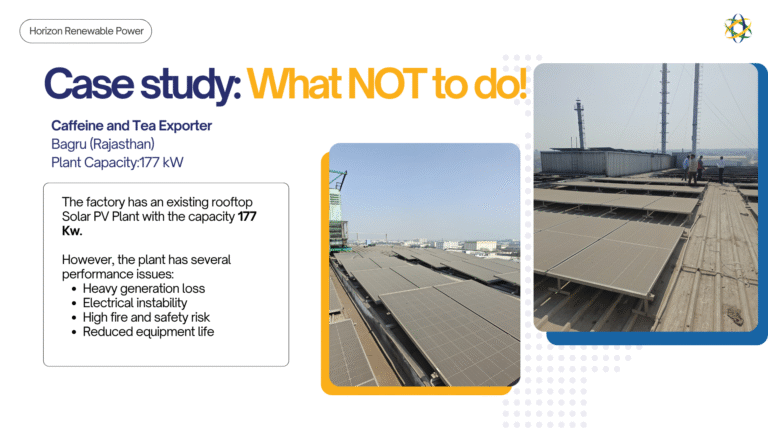
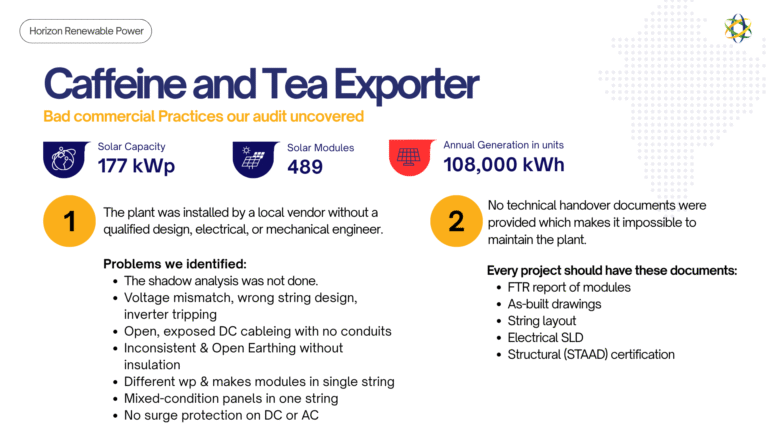
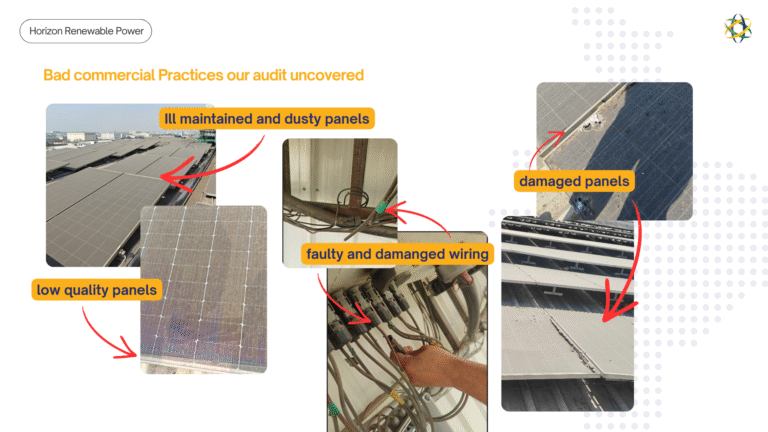
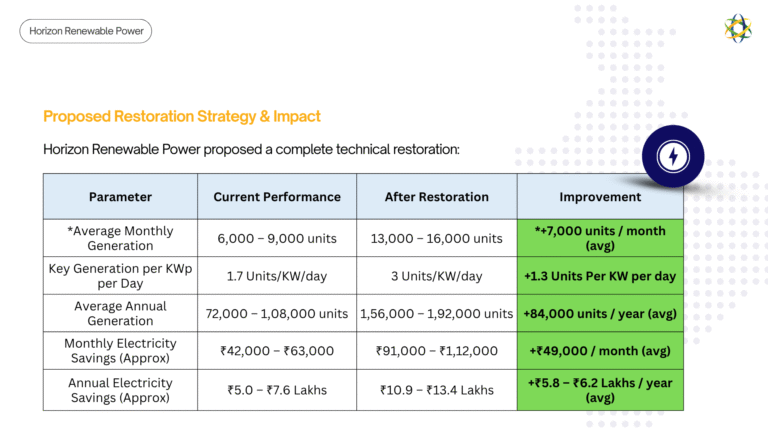
What Horizon Found: A full audit revealed a catalogue of technical failures, all stemming from the original installation being done without any qualified design, electrical, or mechanical engineer on the project:
Problem Identified | Root Cause | Impact on Plant | |
System Design | Mixed module wattages (330 Wp & 545 Wp) in same system | No proper engineering design or string planning | Severe mismatch losses, reduced generation efficiency |
String Configuration | Incorrect string design with voltage mismatch | Lack of technical expertise during installation | Frequent inverter tripping (7–8 times/day), system instability |
DC Cabling | Open, exposed cables without conduits | Non-compliant installation practices | High fire risk, insulation damage, long-term reliability issues |
Earthing System | Incomplete and exposed earthing | Poor safety planning and execution | Shock hazard, lightning vulnerability, unsafe operation |
Surge Protection | No DC/AC Surge Protection Devices (SPDs) | Cost-cutting and lack of compliance awareness | Risk of inverter damage and system failure during surges |
Performance Analysis | No shadow analysis conducted | Absence of pre-installation site assessment | Reduced generation due to avoidable shading losses |
Documentation | Missing technical handover documents (SLD, layouts, certifications) | Informal installation by unqualified vendor | Difficult troubleshooting, increased restoration cost and time |
After Horizon’s complete DC-side restoration, rewiring, string reconfiguration, earthing correction, SPD installation, and inverter stabilisation, the plant’s expected output more than doubled:
Parameter | Before (poor installation) | After Restoration |
Monthly Generation | 6,000–9,000 units | 13,000–16,000 units |
Generation per kWp/day | 1.7 units | 3.0 units |
Annual Savings | ₹5.0–₹7.6 Lakhs | ₹10.9–₹13.4 Lakhs |
Monthly Savings | ₹42,000–₹63,000 | ₹91,000–₹1,12,000 |
System Safety | High fire & shock risk | Code-compliant & safe |
The factory owner paid for a 177 kW system but received the benefit of only a 60–70 kW system due to design failures. Not only did they lose the money they could have saved with smaller electricity bills, they also had to bear the additional cost of restoration, which would not have been necessary with a quality original installation.
Here’s what a credible commercial EPC provider should offer, and what separates a well-executed system from a rushed installation:
✓ Advanced 3D Shadow Analysis & Generation Simulation: Your actual roof geometry, obstructions, and seasonal sun path modelled before a single panel is specified.
✓ Accurate, transparent ROI calculation: Based on your actual load, tariff, and site-specific irradiance — not a generic template.
✓ Proper string design: Matching module wattage and make within each string to prevent current imbalance and inverter trips.
✓ Tier-1, bankable solar modules: BIS-certified, IEC 61215 and IEC 61730 compliant, listed on MNRE’s Approved List of Models and Manufacturers (ALMM).
✓ Best-in-class inverters: From established manufacturers with a proven track record and local service network.
✓ Full Balance of System (BoS) quality check: Galvanised or aluminium mounting structures, DC cabling in conduits, ACDB/DCDB panels, and surge protection devices (SPDs) on both DC and AC sides.
✓ In-house engineering and installation team: Not subcontracted to local contractors who may have no solar-specific training.
✓ Quality and safety protocols on site: Earthing verification, insulation testing, and electrical safety checks before commissioning.
✓ Zero hidden costs: A fixed-price contract with a complete Bill of Materials and no post-installation surprises.
✓ Complete technical handover: Factory Test Reports, As-Built Drawings, String Layout, Electrical SLD, and Structural certification.
✓ Written performance warranty with a payoff clause: Minimum 5-year guarantee of >78% of rated generation (equivalent to 4–4.5 kWh/kWp/day averaged across the year).
✓ Annual Maintenance Contract (AMC): Preventive health checkups, cleaning, and remote generation monitoring via software.
✓ DISCOM approvals and net-metering documentation: Handled and completed before handover.
Installing a quality solar system is step one. Maintaining that quality over 25 years is step two, and it is equally important. Solar is not a set-and-forget asset. Like any capital equipment, it requires scheduled care to perform at optimum capacity.
✓ | Remote generation monitoring: A good installer provides software-based monitoring so both you and the installer can track daily and monthly output against the expected baseline. Any underperformance is flagged immediately. |
| ✓ | Preventive system health checks: At a minimum, annual checking of inverter performance, string voltages, earthing integrity, and panel cleanliness. |
| ✓ | Annual cleaning: In India’s dust-heavy environment, panel soiling alone can reduce output by 5–15%. Scheduled cleaning is a measurable ROI activity, not an optional luxury. |
✓ | Warranty claim management: A quality installer maintains records and manages panel and inverter warranty claims on your behalf — not something you should have to pursue independently. |
✓ | Performance warranty enforcement: If your system is under a performance warranty, there should be a clear, contractual mechanism for what happens if generation falls below the guaranteed level. |
Even with a quality installation, knowing what to watch for protects your returns:
Horizon’s recommendation: Request a generation report from your installer at the end of Year 1, Year 3, and Year 5. Compare actual output against the originally projected figures. If the gap is material and unexplained, commission an independent audit. A well-installed system should closely track its projections.
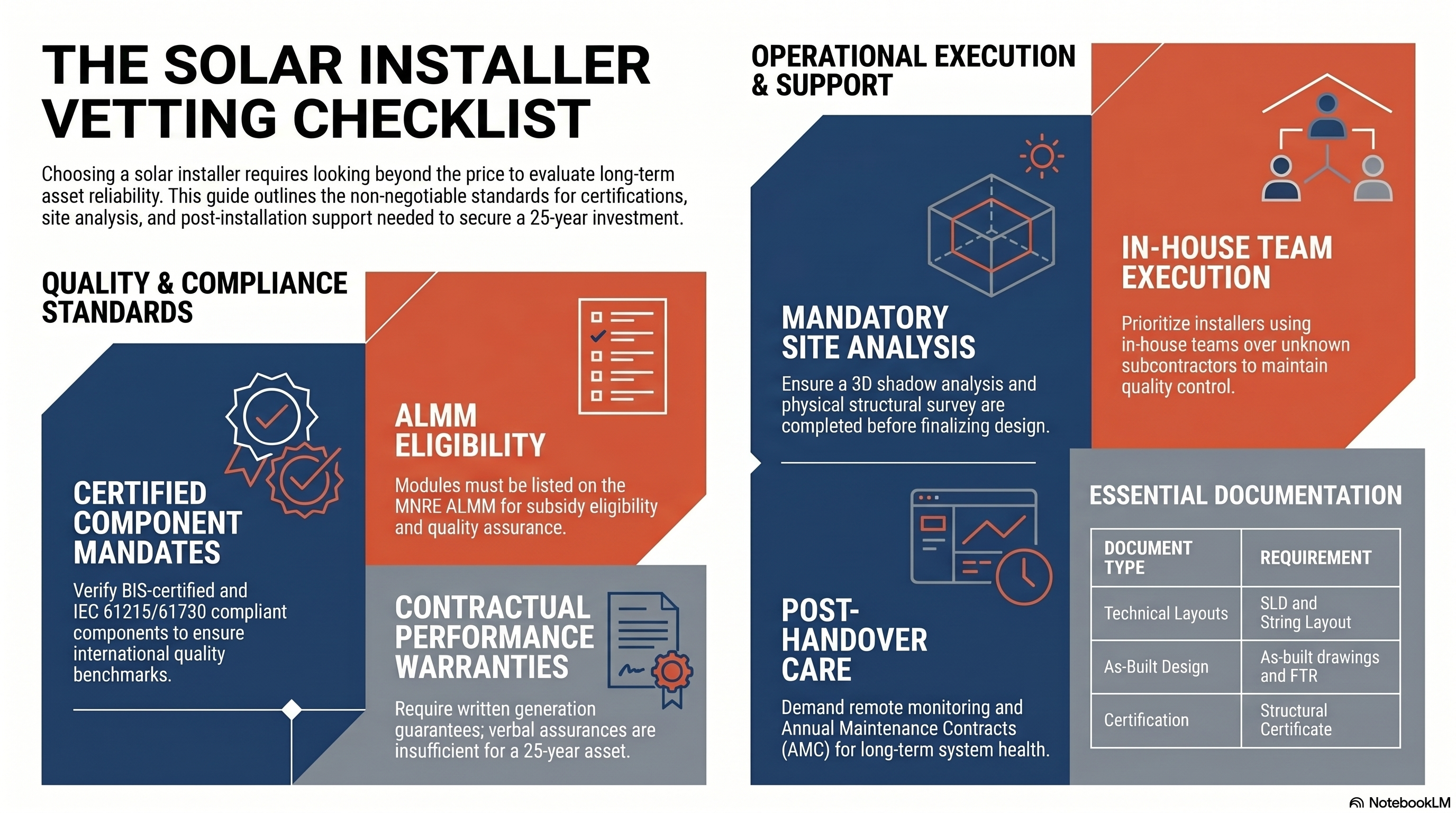
Choosing the right installer is as important as choosing the right system. Before you sign, here are a few key questions that can help you separate a reliable partner from a risky one:
If they cannot confirm this clearly, you can strike them off your list.
Required for government subsidy eligibility; also a quality proxy.
Non-negotiable for any credible commercial quote. A good solar company will give a detailed 3D report as step one and follow it up with a physical site survey.
Verbal assurances do not count. Require a contract.
Subcontracting to unknown local contractors is a quality risk.
Minimum: FTR, SLD, string layout, as-built drawings, structural certificate.
Post-installation care is not optional for a 25-year asset.
Over the course of this article, one idea should be clear – Solar is not expensive. Underperforming solar is.
A system that delivers ₹1 per unit of electricity over 25 years is one of the most valuable assets a business can own. But that outcome is not guaranteed by installation; it is achieved through engineering.
At Horizon, we approach every project by evaluating solar not as a product, but as long-term infrastructure that must perform consistently and predictably over decades.
If you are evaluating solar for your facility, we can help you assess proposals not just on cost, but on what they will actually deliver over time.