
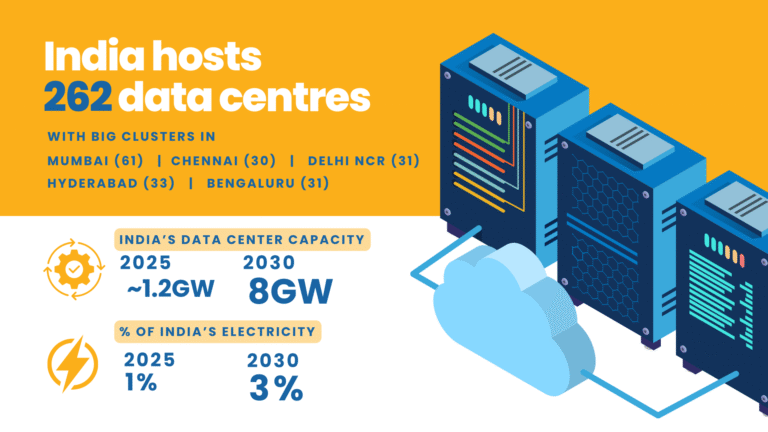
A few years ago, most people didn’t even know where their data ‘went’ after hitting send. Today, India hosts 262 data centres, ranking 7th globally, just behind France and Canada. Not bad for a country that only truly entered the hyperscale race in the last decade.
Driven by the rapid expansion of cloud infrastructure, AI workloads, and enterprise digitisation the current cumulative capacity of data centers in India stands at ~1.2–1.4 GW and is expected to reach 8 GW by 2030 spurred by massive investments such as Reliance’s 3 GW mega-campus at Jamnagar with a $20–30B outlay and from Anant Raj Ltd., a Delhi-based developer, investing $2.1B aiming for a data center with a 300 MW by 2032.
This expansion is predicted to consume about 3% of India’s electricity in 2030, up from less than 1% currently.
Which brings us to the critical question: how do we power the data-centre boom sustainably, affordably, and reliably?
As electricity demand spikes and global tech giants hard-pivot toward net-zero operations, renewable energy, especially solar, is emerging as the strategic solution for India’s data-centre future.
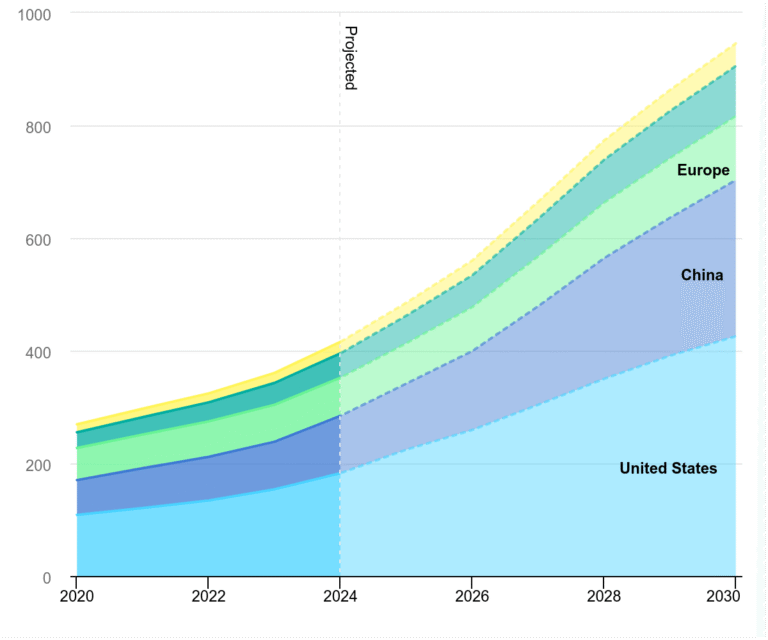
According to a recent report from the International Energy Agency (IEA), data centres accounted for around 1.5% of the world’s electricity consumption in 2024, or 415 terawatt-hours (TWh).
The United States had the largest share of global data centre electricity consumption (45%), followed by China (25%) and Europe (15%).
Globally, data centre electricity consumption has grown by around 12% per year since 2017, more than four times faster than the rate of total electricity consumption, and by 2030, electricity consumption is predicted to be around 945 TWh!
AI-focused data centres can draw as much electricity as power-intensive factories such as aluminium smelters, but they are much more geographically concentrated. For example, nearly half of the data centre capacity in the United States is concentrated in five regional clusters, and the same is true in India, where five cities have the highest concentration of data centres.
The sector accounts for substantial shares of electricity consumption in local markets. Data centres operate 24/7, and electricity costs can account for the single largest component of operating expenditure. As loads increase, so does exposure to electricity price volatility. In some regions, such as the PJM grid in the United States, analysts warn that rising data-centre demand could drive electricity rates up by as much as 60% in five years.
Meeting this rising electricity demand through conventional fossil-fuel-based power alone is neither sustainable nor economically prudent. Solar, along with a battery option, can help meet this increasing demand to a large extent.
Electricity is the largest OPEX line item for any data centre. Solar reduces dependence on volatile coal-powered grid tariffs. With battery storage, it also offers energy independence, making it more stable during critical times, such as outages triggered by natural disasters or other events.
Solar has zero operational emissions and is the fastest pathway to RE100 goals adopted by global hyperscalers.
Renewables reduce load on congested urban grids, a critical advantage in hubs like Mumbai, Noida, and Bengaluru.
Apple, Google, and other hyperscalers are already on 100% renewable pathways. Solar is not just sustainable, it’s the new global baseline.
Several organisations in India are already demonstrating what a renewable-powered data-centre future can look like:
Internationally, the transition is even more advanced. Apple has powered all its data centres with 100% renewable energy since 2014, with facilities like its Mesa, Arizona site using 530 million kWh per year entirely from solar. Google is experimenting with 24/7 carbon-free energy, combining solar, wind, hydro, and storage, and has signed a 1.5 TWh, 15-year solar PPA with TotalEnergies to support operations in Ohio.
These examples show that renewable integration is not aspirational; it is already becoming mainstream.
At Horizon Renewable Power, we work closely with industrial and high-load customers to design and implement solar solutions that deliver long-term value.
This model allows data-centre operators to adopt solar with no upfront investment. Horizon manages the system end-to-end, while clients pay only for the electricity generated.
For organisations that prefer to own their solar assets, we offer complete engineering, procurement and construction services, supported by finance partnerships enabling low-EMI loans.
Given the importance of uptime and reliability, our maintenance packages include automated cleaning and continuous monitoring to ensure peak system performance.
From feasibility studies and design to net-metering, installation, monitoring, and long-term service, Horizon provides a comprehensive and seamless solar deployment experience.
Beyond installation, Horizon provides comprehensive sustainability advisory services to help clients strengthen and demonstrate their environmental leadership. This includes detailed energy audits, carbon-reduction planning, and guidance on renewable-energy reporting frameworks. We assist data centres in documenting sustainability activities and showcase them to stakeholders and global partners.
As India accelerates into an AI-powered future, the data-centre industry stands at a defining moment. The facilities that lead will be those that secure clean, stable, and future-proof energy today, not years from now.
If you are building, expanding, or rethinking your data-centre energy strategy, Horizon Renewable Power is ready to support you with practical, high-impact solutions that deliver both performance and credibility.
Reach out to our team to begin the conversation. Call us at +91 9811121157 | 84482 95965
Standard rooftop solar systems are grid-tied, which means they work only when the power grid is active. During a power cut, these systems shut down for safety reasons unless you’ve opted for a hybrid solar system with battery backup.
At night, since solar panels need sunlight to generate electricity, they don’t produce power. However, net metering ensures that the excess solar energy you export during the day offsets your nighttime usage, keeping your electricity bill low.
As a rule of thumb, a 1 kW system requires around 80–100 sq. ft. of shadow-free roof area. For a typical home with a monthly bill of ₹2,000–₹3,000, a 3–5 kW system is usually sufficient, which needs 300–500 sq. ft. of usable roof space.
Flat concrete rooftops are ideal, but we can also work with sloped roofs or terrace railings using customized mounting structures.
The cost depends on the system size and whether you're opting for battery backup. For most homes, a 3 kW system without batteries may cost around ₹1.5–2 lakh after subsidies.
Thanks to the PM Surya Ghar scheme, residential customers are eligible for up to 40% subsidy, and we help you handle all paperwork for availing this benefit. Financing and EMI options are also available.
Solar systems are low maintenance. As a homeowner, you just need to clean the panels every 15–30 days with water and a soft cloth to remove dust and bird droppings.
We recommend annual inspections to check wiring, inverter health, and performance. If you prefer, we also offer Annual Maintenance Contracts (AMCs) so you don’t have to worry about upkeep at all.
At Horizon Renewable Power, our mission is to transform India’s rooftops into efficient, self-sustaining energy hubs. We aim to make solar energy affordable and accessible to a wide range of residential, commercial, and industrial customers through two models — EPC (Engineering, Procurement, and Construction) and RESCO (Renewable Energy Service Company).
Our three-year goal is ambitious yet achievable: to commission 1,000 MW of rooftop solar capacity across India. This expansion not only supports India’s clean energy ambitions but also drives significant environmental and economic impact across the communities we serve.
Installing a solar rooftop system brings a host of advantages. First and foremost, it offers substantial reductions in electricity costs, with savings of up to 60% on energy bills. Solar panels also allow homeowners and businesses to make productive use of idle roof spaces by converting them into power generators.
Beyond financial savings, solar power contributes meaningfully to the environment by reducing carbon emissions—each unit of solar electricity generated can prevent around 0.8 kg of CO₂ emissions. Additionally, solar energy systems help properties achieve sustainability certifications and net-zero targets while enhancing the visual appeal of the building with modern, sleek panel designs.
Our installation process is thorough, seamless, and professionally managed. It begins with a detailed site survey to assess the roof’s condition, orientation, shading, and load capacity. Following this, our engineers design a customized solar solution based on your specific needs.
We then handle all regulatory permissions and approvals required by local authorities. The installation itself involves setting up strong mounting structures, precision-aligning the solar panels, completing electrical cabling, and integrating inverters and safety devices. Once installed, the system undergoes a series of performance tests and inspections to ensure optimum output before the final commissioning and handover. We also guide you through setting up remote monitoring for real-time tracking
While solar panels may look similar on the surface, the difference lies in quality, design, and execution. At Horizon Renewable Power, we strictly use high-efficiency mono PERC and bifacial solar modules that guarantee higher energy yield. Our inverters and cables are sourced from top-tier global manufacturers, ensuring greater system reliability.
Moreover, our deep design and engineering expertise allow us to create solar systems that blend functionality with aesthetics, adapting installations to local climatic and architectural conditions. Above all, we strictly adhere to MNRE and BIS guidelines, ensuring that every project stands the test of time both technically and legally.
We cater to three major customer segments:
Each segment is served by dedicated teams with specialized technical knowledge to ensure tailored, high-performance solutions.
We offer two flexible financing models:
Both models are backed by thorough maintenance and support services, ensuring complete peace of mind.
Yes, particularly for residential customers. The PM Surya Ghar Yojana and other MNRE-led schemes provide significant capital subsidies of up to 40% on rooftop solar systems for homes.
Commercial and industrial customers, while typically ineligible for direct subsidies, can benefit from tax advantages and accelerated depreciation on solar assets.
Horizon assists all eligible customers in completing subsidy documentation and navigating the often tedious government application process, making the transition to solar smooth and hassle-free.
The financial benefits of solar power are both immediate and long-term. With an EPC model, customers can expect a payback period of 3–5 years depending on their location, energy tariff, and system size.
For RESCO clients, the advantage is immediate — there’s no capital investment required, and savings begin from the first electricity bill post-installation.
Over the system’s 25-year life, customers enjoy locked-in electricity rates, protection against rising energy costs, and significant cumulative savings that greatly outperform traditional investments.
Our rooftop solar systems are built to last.
Absolutely. Customer support is a critical part of our commitment.
Every installation includes access to real-time system monitoring, allowing customers to track generation, savings, and performance from their smartphones or computers.
Our dedicated operations team handles proactive maintenance, warranty claims, and system optimizations. Whether you choose EPC or RESCO, you can expect full after-sales service, 24x7 support, and scheduled site visits to ensure your solar system operates at peak efficiency
Net metering is a mechanism that allows you to feed excess solar electricity back into the grid. In return, your utility company credits you for the surplus, which offsets your electricity consumption during times when your panels aren’t producing enough (like nighttime).
This results in lower electricity bills and maximizes the return on your investment.
From an environmental perspective, every kilowatt-hour (kWh) generated by your solar rooftop reduces about 0.8 kg of carbon dioxide emissions. By switching to solar, you contribute significantly toward combating climate change and moving India closer to its green energy targets.
Customers often worry about issues like technology reliability, maintenance obligations, upfront costs, and long-term savings.
Our goal is to ensure that transitioning to solar is not just a wise financial decision, but also a smooth, trusted, and rewarding experience.