
For most industrial and commercial (C&I) leaders, solar energy is still framed as a cost-saving initiative—an operational decision driven by tariffs and payback periods. That framing is incomplete.
In 2026, solar is fundamentally a regulatory asset class. With solar investment, a business’s Internal Rate of Return (IRR) is shaped less by sunlight and more by state-level policy shifts, DISCOM (Distribution Company) behaviour, and evolving compliance mandates. Two identical factories in Rajasthan and Haryana will see dramatically different ROIs—not because of the weather, but because of the legal architecture.
At the center of solar power regulations lies the Electricity Act, 2003, which liberalized generation and enabled open access, effectively allowing private players to generate and procure power outside traditional utility monopolies. The act includes provisions for preferential tariffs and quotas to encourage the adoption of renewable energy. Mandatory procurement of renewable energy for distribution licensees and facilitation of grid connectivity were incorporated.
National Tariff Policy 2006 includes the Renewable Purchase Obligation (RPO) to fix the minimum percentage of procurement of energy consumption by the state governments. The central and state electricity regulatory commissions must purchase a certain percentage of grid-based power from renewable sources. Solar power is to comprise 8% of power purchases by states by 2022. It also lays out the regulations for open access.
In October 2025, the Draft Electricity (Amendment) Bill, 2025 was released for public feedback, and it proposes a penalty for non-compliance with RPO. The penalty for non-compliance will range from 35 paise to 45 paise per unit of electricity purchased.
The original National Electricity Policy 2005 version was light on solar power and only spoke in passing about using solar energy as solar water heating systems and solar passive architecture to promote energy conservation. However, the 2026 draft of the National Electricity Policy sets out concrete steps to promote and utilize solar power. The draft policy sets out time-bound goals for solarizing agricultural activities, consumer-driven peer-to-peer (P2P) energy trading, pricing, investment guidance, and more.
Together, these policies transformed solar from an alternative to a compliance-driven necessity.
While there are multiple variations, most commercial and industrial solar adoption in India falls into four broad models.
Captive solar is often the most straightforward to understand. The consumer owns a significant stake (at least 26%) in the generating asset and consumes the majority of the power produced (at least 51%), as specified under Rule 3 of the Electricity Rules, 2005.
For many large industrial players, this model offers a sense of control over both the asset and long-term energy costs, such as the 125 MWp solar plant in Nagpur by CtrlS datacenters. Captive solar also allows companies to bypass several grid-related charges that apply to third-party procurement.
However, this control comes with regulatory expectations. Captive structures must comply with ownership and consumption thresholds, and these are increasingly scrutinized. The recently introduced Electricity (Amendment) Rules, 2026, have made captive solar easier for businesses by clarifying ownership provisions, simplifying rules for group captive arrangements, and establishing a clear verification mechanism. A new provision has been added to avoid imposition of charges on the captive consumers by the Distribution licensees pending verification of the captive status.
For businesses with stable, predictable energy demand and the ability to invest in or co-invest in generation assets, captive solar remains one of the most attractive pathways. But it requires discipline in structuring and compliance, not just capital.
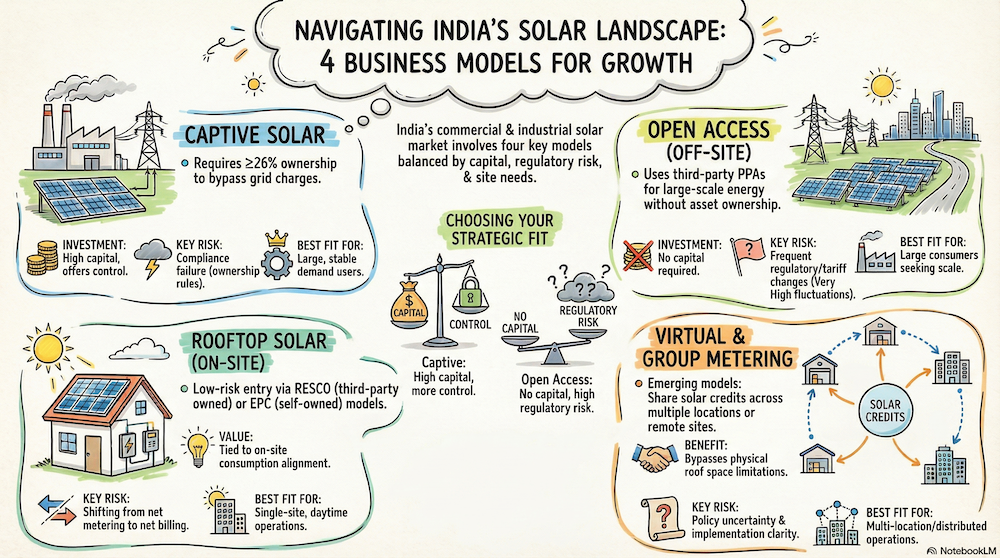
Open access has emerged as one of the most powerful mechanisms for large-scale solar adoption.
Under this model, a business procures power from a third-party solar developer, often through long-term power purchase agreements (PPAs). The electricity is generated off-site and transmitted through the grid to the consumer.
The appeal is clear: access to large solar capacities without owning the asset, and of course, it is more cost-effective as open access solar tariffs in India are often lower than industrial grid tariffs.
But open access is also where regulation becomes most visible. Most additional charges, such as cross-subsidy surcharges, wheeling charges, and banking fees, vary widely across states and are unpredictable. Regulatory revisions can alter cost structures mid-project, affecting long-term returns.
For large consumers with high and consistent energy demand, open access remains a compelling option, but it can be impacted by regulatory changes.
Rooftop solar has two models – RESCO (Third party owned/OPEX) and EPC (Self owned/CAPEX). Rooftop solar plants, especially under the RESCO model, has gained traction among businesses looking for a low-risk entry into solar.
In this structure, a third-party developer installs and owns the system on the consumer’s premises, and the consumer pays for the electricity generated, typically at a tariff lower than grid power. The EPC structure requires a bigger investment from the business; however, a large chunk of the cost can be financed by a bank and it has the clear advantage of complete ownership.
Rooftop solar has clear financial benefits, quick IRR, and the peace of mind provided by a tested technology stack; however, it is deeply tied to net metering or net billing regulations, which determine how excess power exported to the grid is valued.
Across several states, regulatory frameworks are evolving from net metering, where exports offset consumption, to net billing, where exported energy is compensated differently.
This shift makes consumption alignment increasingly important. Rooftop systems tend to deliver the strongest value when generation closely matches on-site demand, particularly during daytime operations. As a result, rooftop solar remains highly effective for facilities with strong daytime loads and businesses seeking a quick, low-risk, and simple solar solution.
One of the most significant regulatory evolutions in India’s solar landscape is the emergence of virtual and group net metering.
These models are designed to solve a fundamental limitation of rooftop solar: not every business has the right kind of roof, or sufficient space, to install solar.
Virtual Net Metering
Under virtual net metering, a single solar plant can serve multiple consumers. The energy generated is virtually allocated across different users, allowing them to benefit from solar without hosting the system on-site.
Group Net Metering
This model allows a single entity to distribute solar generation across multiple electricity connections, particularly useful for companies with operations spread across locations.
Virtual Net Metering (VNM) and Group Net Metering (GNM) both allow sharing solar credits from a single plant, but differ in user structure. VNM allows multiple, independent consumers (like apartment residents) to share a remote plant, while GNM applies to a single entity with multiple, connected accounts (like one company with multiple offices).
Together, these frameworks are expanding access to solar in meaningful ways:
For businesses with distributed operations, these emerging models offer a way to optimize solar at a portfolio level, rather than at an individual site level.
As businesses begin to optimize not just how they generate solar power but how they use it, Battery Energy Storage Systems (BESS) are emerging as a critical strategic layer.
BESS is essential for storing excess solar/wind energy during the day for usage during peak demand hours, offering grid stabilization. But in India’s regulatory context, its real value lies in decoupling generation from consumption, giving businesses control over when and how energy is used.
Between 2022 and 2032, India plans to add over 47 GW of battery storage capacity, with a total investment of around ₹3.5 lakh crore. Projects are accelerating due to falling battery costs and government incentives. This has led to the emergence of new models such as “Battery as a Service” (BaaS) and “Storage as a Service” (SaaS), which allow users to avoid high upfront costs.
BESS becomes particularly important as regulatory frameworks evolve.
In rooftop solar, as net billing gradually replaces net metering, exporting excess energy is becoming less valuable. Storage allows that energy to be retained and used during evening or peak tariff periods, improving overall savings.
In captive setups, BESS enhances self-consumption, especially for industries with continuous or multi-shift operations. Instead of relying on grid power after sunset, stored solar energy can bridge the gap, extending the utility of the solar asset.
For open access users, storage adds a new layer of flexibility. It can help manage generation variability, reduce reliance on banking mechanisms, and optimize consumption during high-cost periods.
Even in emerging models like virtual and group net metering, while integration is still evolving, storage is expected to play a role in enabling more predictable and balanced energy allocation across distributed consumption points.
That said, BESS adoption today is still selective. Its financial viability depends on:
The Approved List of Models and Manufacturers (ALMM) has become an important part of India’s solar ecosystem, particularly in ensuring quality standards and promoting domestic manufacturing.
In simple terms, ALMM specifies which solar modules (and increasingly, cells) are approved for use in certain project categories, especially those linked to government schemes or specific regulatory frameworks. The government has recently extended the ALMM list to include solar ingots and wafers, effective June 1, 2028. Under the latest order, it is mandatory to use the ALMM List for all net metering and open access plants, which effectively means all solar plants except captive ones. This directly impacts project costs, which might rise in the short term as supply chains sort themselves out, but will certainly make solar cheaper (and of better quality) in the long run while boosting domestic manufacturing capabilities.
There is no single “best” solar model in India. Instead, the right choice depends on a combination of:
A large manufacturing plant with stable demand may benefit from captive or open access structures. A distributed logistics network may find greater value in virtual or group net metering. An SME may prefer the simplicity of a rooftop RESCO/EPC model.
Increasingly, the most effective strategies are not singular; they are hybrid. Companies are combining rooftop solar with open access for scale and exploring emerging models for distributed loads. This portfolio approach allows businesses to balance risk, optimize costs, and adapt to regulatory shifts.
Here’s an overview of the features and advantages of all 4 models:
|
Parameter |
Captive Solar |
Open Access Solar |
Rooftop Solar (RESCO/EPC) |
Virtual / Group Net Metering |
|
Ownership |
Partial ownership (≥26%) in generation asset |
Third-party owned |
Third-party owned (RESCO) or self-owned (EPC) |
Typically third-party or centralized asset |
|
Power Source Location |
Off-site (usually) |
Off-site |
On-site (your facility) |
Off-site, virtually allocated |
|
Capital Investment |
Moderate to high (equity required) |
None |
None (RESCO) / Moderate (EPC) |
Low to moderate (depends on structure) |
|
Key Charges Applicable |
Limited (if compliant captive) |
Multiple (CSS, wheeling, banking) |
Minimal |
Depends on state regulations |
|
Policy Sensitivity |
Medium (compliance scrutiny) |
Very high (frequent changes) |
High (net metering → net billing shift) |
High (policy still evolving) |
|
Best Fit For |
Large, stable demand users |
Large energy consumers seeking scale |
Single-site, daytime-heavy consumption |
Multi-location or distributed operations |
|
Scalability |
High |
Very high |
Limited by rooftop size |
High (portfolio-level allocation) |
|
Execution Complexity |
Moderate |
High |
Low |
Moderate |
|
Key Risk |
Compliance failure (ownership/consumption rules) |
Regulatory changes impacting costs |
Reduced export value |
Policy uncertainty / implementation clarity |
India’s solar market is entering a new phase. The early years were defined by incentives and rapid adoption. The next phase will be defined by:
At the same time, innovation in business models, particularly around distributed solar and BESS, will continue to expand access and flexibility.
The companies that will succeed in India’s solar transition will not necessarily be those that install the most capacity. They will be the ones who choose the right model, in the right location, at the right time, and adapt as regulation evolves.
At Horizon, we partner with businesses to move beyond one-off installations toward integrated, regulation-aware energy strategies that evolve with the market. We work with C&I consumers to:
If you’re thinking about solar not just as a project, but as a long-term capability, it’s worth starting that conversation early.
Standard rooftop solar systems are grid-tied, which means they work only when the power grid is active. During a power cut, these systems shut down for safety reasons unless you’ve opted for a hybrid solar system with battery backup.
At night, since solar panels need sunlight to generate electricity, they don’t produce power. However, net metering ensures that the excess solar energy you export during the day offsets your nighttime usage, keeping your electricity bill low.
As a rule of thumb, a 1 kW system requires around 80–100 sq. ft. of shadow-free roof area. For a typical home with a monthly bill of ₹2,000–₹3,000, a 3–5 kW system is usually sufficient, which needs 300–500 sq. ft. of usable roof space.
Flat concrete rooftops are ideal, but we can also work with sloped roofs or terrace railings using customized mounting structures.
The cost depends on the system size and whether you're opting for battery backup. For most homes, a 3 kW system without batteries may cost around ₹1.5–2 lakh after subsidies.
Thanks to the PM Surya Ghar scheme, residential customers are eligible for up to 40% subsidy, and we help you handle all paperwork for availing this benefit. Financing and EMI options are also available.
Solar systems are low maintenance. As a homeowner, you just need to clean the panels every 15–30 days with water and a soft cloth to remove dust and bird droppings.
We recommend annual inspections to check wiring, inverter health, and performance. If you prefer, we also offer Annual Maintenance Contracts (AMCs) so you don’t have to worry about upkeep at all.
At Horizon Renewable Power, our mission is to transform India’s rooftops into efficient, self-sustaining energy hubs. We aim to make solar energy affordable and accessible to a wide range of residential, commercial, and industrial customers through two models — EPC (Engineering, Procurement, and Construction) and RESCO (Renewable Energy Service Company).
Our three-year goal is ambitious yet achievable: to commission 1,000 MW of rooftop solar capacity across India. This expansion not only supports India’s clean energy ambitions but also drives significant environmental and economic impact across the communities we serve.
Installing a solar rooftop system brings a host of advantages. First and foremost, it offers substantial reductions in electricity costs, with savings of up to 60% on energy bills. Solar panels also allow homeowners and businesses to make productive use of idle roof spaces by converting them into power generators.
Beyond financial savings, solar power contributes meaningfully to the environment by reducing carbon emissions—each unit of solar electricity generated can prevent around 0.8 kg of CO₂ emissions. Additionally, solar energy systems help properties achieve sustainability certifications and net-zero targets while enhancing the visual appeal of the building with modern, sleek panel designs.
Our installation process is thorough, seamless, and professionally managed. It begins with a detailed site survey to assess the roof’s condition, orientation, shading, and load capacity. Following this, our engineers design a customized solar solution based on your specific needs.
We then handle all regulatory permissions and approvals required by local authorities. The installation itself involves setting up strong mounting structures, precision-aligning the solar panels, completing electrical cabling, and integrating inverters and safety devices. Once installed, the system undergoes a series of performance tests and inspections to ensure optimum output before the final commissioning and handover. We also guide you through setting up remote monitoring for real-time tracking
While solar panels may look similar on the surface, the difference lies in quality, design, and execution. At Horizon Renewable Power, we strictly use high-efficiency mono PERC and bifacial solar modules that guarantee higher energy yield. Our inverters and cables are sourced from top-tier global manufacturers, ensuring greater system reliability.
Moreover, our deep design and engineering expertise allow us to create solar systems that blend functionality with aesthetics, adapting installations to local climatic and architectural conditions. Above all, we strictly adhere to MNRE and BIS guidelines, ensuring that every project stands the test of time both technically and legally.
We cater to three major customer segments:
Each segment is served by dedicated teams with specialized technical knowledge to ensure tailored, high-performance solutions.
We offer two flexible financing models:
Both models are backed by thorough maintenance and support services, ensuring complete peace of mind.
Yes, particularly for residential customers. The PM Surya Ghar Yojana and other MNRE-led schemes provide significant capital subsidies of up to 40% on rooftop solar systems for homes.
Commercial and industrial customers, while typically ineligible for direct subsidies, can benefit from tax advantages and accelerated depreciation on solar assets.
Horizon assists all eligible customers in completing subsidy documentation and navigating the often tedious government application process, making the transition to solar smooth and hassle-free.
The financial benefits of solar power are both immediate and long-term. With an EPC model, customers can expect a payback period of 3–5 years depending on their location, energy tariff, and system size.
For RESCO clients, the advantage is immediate — there’s no capital investment required, and savings begin from the first electricity bill post-installation.
Over the system’s 25-year life, customers enjoy locked-in electricity rates, protection against rising energy costs, and significant cumulative savings that greatly outperform traditional investments.
Our rooftop solar systems are built to last.
Absolutely. Customer support is a critical part of our commitment.
Every installation includes access to real-time system monitoring, allowing customers to track generation, savings, and performance from their smartphones or computers.
Our dedicated operations team handles proactive maintenance, warranty claims, and system optimizations. Whether you choose EPC or RESCO, you can expect full after-sales service, 24x7 support, and scheduled site visits to ensure your solar system operates at peak efficiency
Net metering is a mechanism that allows you to feed excess solar electricity back into the grid. In return, your utility company credits you for the surplus, which offsets your electricity consumption during times when your panels aren’t producing enough (like nighttime).
This results in lower electricity bills and maximizes the return on your investment.
From an environmental perspective, every kilowatt-hour (kWh) generated by your solar rooftop reduces about 0.8 kg of carbon dioxide emissions. By switching to solar, you contribute significantly toward combating climate change and moving India closer to its green energy targets.
Customers often worry about issues like technology reliability, maintenance obligations, upfront costs, and long-term savings.
Our goal is to ensure that transitioning to solar is not just a wise financial decision, but also a smooth, trusted, and rewarding experience.